
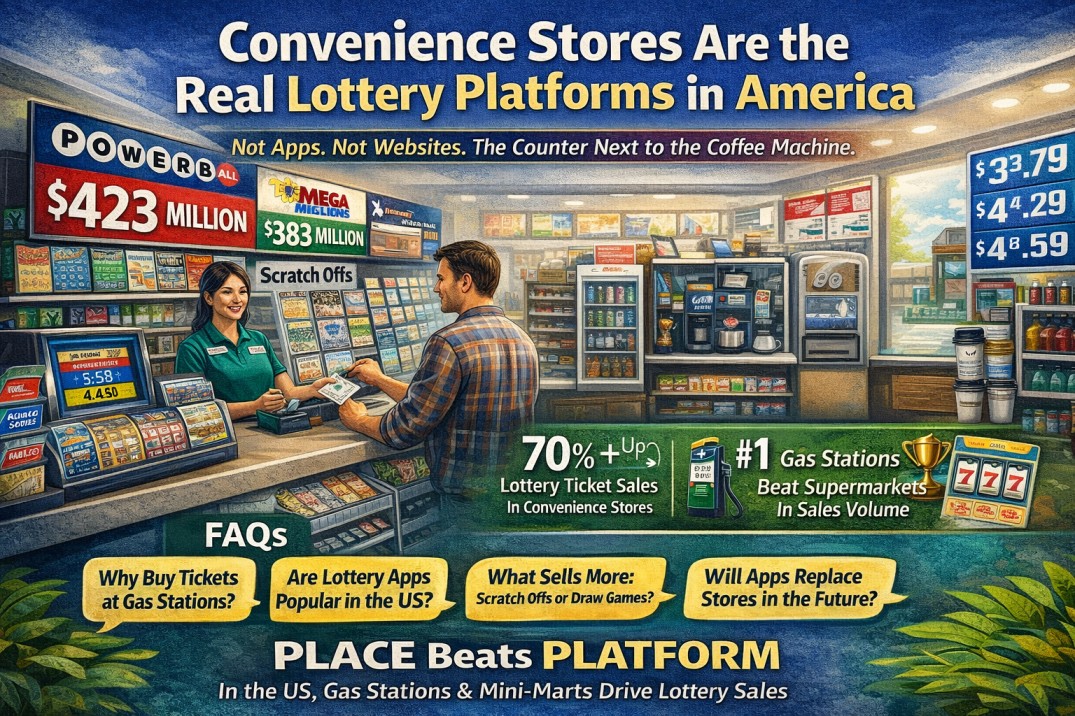
Not Apps. Not Websites. The Counter Next to the Coffee Machine.
In America, the lottery does not live on a screen.
It lives next to cigarettes, coffee, and fuel receipts.
If you want to understand how Americans really buy lottery tickets, stop looking at apps and start looking at convenience stores.
Because in the US, the convenience store is the platform.
The Reality Most Tech Narratives Miss
Yes, America has lottery websites.
Yes, there are mobile apps.
No, they are not the default behaviour.
The default behaviour is this:
- You walk in for gas or snacks
- You see the jackpot number glowing behind the counter
- You add a ticket without planning to
That impulse does not happen online.
Why Convenience Stores Win Where Apps Fail
1. Lottery Is an Add On, Not a Destination
Americans rarely wake up thinking, I will buy a lottery ticket today.
They wake up thinking:
- I need fuel
- I need coffee
- I need cigarettes
- I need milk
The lottery slips into the transaction quietly.
This is behavioural gold.
Apps demand intent.
Counters exploit proximity.
2. The Counter Is a Psychological Trigger
Behind the cashier:
- Powerball jackpot
- Mega Millions total
- Scratch off displays
These are not ads.
They are nudges.
They sit exactly where the customer pauses, waits, and looks around.
That pause is where lottery sales happen.
3. Cash and Card Still Matter
Unlike many countries, the US lottery system is fragmented by state laws.
Some states restrict online ticket sales.
Some allow partial digital flows.
Many still depend on physical validation.
Convenience stores bypass all of this.
Swipe card.
Print ticket.
Done.
No app onboarding. No identity friction.
4. Scratch Offs Are a Store Product, Not a Game
Scratch tickets are designed for physical retail.
Bright colours.
Instant reveal.
Immediate dopamine.
They work best when:
- Hung near the counter
- Handed over physically
- Scratched right outside the store
This is why scratch offs outperform many draw based games in retail heavy states.
The Numbers Tell the Story
In many US states:
- Over 70 percent of lottery ticket sales happen through convenience stores
- Gas stations outsell supermarkets for lottery volume
- Scratch offs dominate retail revenue
This is not because apps are bad.
It is because habit beats innovation.
The American Difference
Compare globally.
India uses UPI driven physical plus digital flows.
Brazil moved fast with PIX and mobile payments.
The Philippines leans on ritual and community sellers.
America stays loyal to:
- Physical retail
- Familiar routines
- Unplanned decisions
The lottery fits neatly into that rhythm.
Convenience Stores Do One Thing Apps Cannot
They remove the feeling of gambling.
Buying a ticket in an app feels intentional.
Buying it at a counter feels casual.
That emotional difference matters.
The less serious it feels, the more people do it.
A Simple Framework: PLACE Beats PLATFORM
For lotteries in the US:
- Place creates impulse
- Platform requires motivation
Impulse scales faster.
That is why every tech led lottery strategy that ignores convenience stores eventually stalls.
FAQs
Why do Americans buy lottery tickets at gas stations?
Because they are already there. Lottery purchases happen as part of routine errands.
Are lottery apps popular in the US?
They exist, but adoption is limited by state laws, trust issues, and habit.
What sells more, scratch offs or draw tickets?
Scratch offs dominate retail sales because they offer instant gratification.
Why have convenience stores stayed dominant?
They combine visibility, habit, and low friction better than any digital platform.
Will apps replace convenience stores in the future?
Unlikely in the near term. Retail behaviour in the US changes slowly, especially for low value impulse purchases.
The Real Insight
In America, the lottery is not a tech product.
It is a retail habit.
Until apps can recreate the moment between coffee and change at the counter, convenience stores will remain the real lottery platforms.
Everything else is just theory.
Convenience stores really do offer that perfect mix of spontaneity and practicality. It’s fascinating how the lottery becomes a part of our routine in such an effortless way, which apps just can’t seem to replicate. The psychology behind impulse buying is so spot-on!