
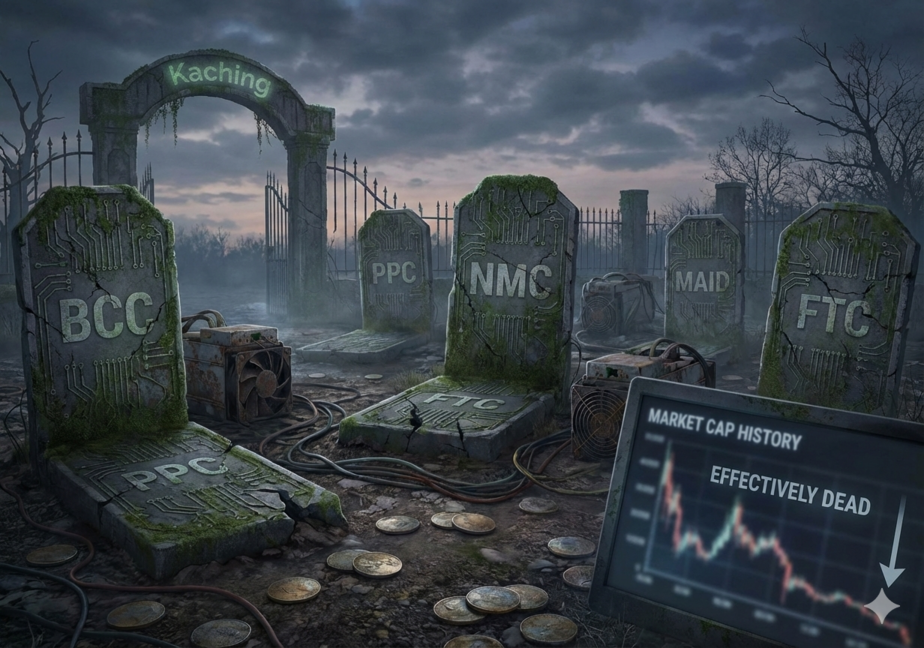
In crypto, popularity can vanish faster than it arrives. Coins that once ruled headlines, exchange volumes, and investor portfolios have quietly faded into obscurity. some abandoned by developers, others crushed by regulation, competition, or broken economics.
While the crypto market still celebrates innovation, these projects serve as reminders that early success doesn’t guarantee long-term survival.
Here are some of the most notable crypto coins that are considered “dead” or effectively inactive today, despite once being massively popular.
BitConnect (BCC): From Top 10 to Total Collapse
At its peak, BitConnect was everywhere promising “guaranteed returns” through a lending model that attracted investors worldwide. The token surged into the top 10 cryptocurrencies by market cap before collapsing in 2018.
Regulatory warnings, an unsustainable business model, and allegations of fraud led to one of the most infamous crashes in crypto history. Today, BitConnect is widely cited as a textbook example of what can go wrong in unregulated markets.
Peercoin (PPC): A Pioneer Left Behind
Peercoin was one of the earliest cryptocurrencies to introduce proof-of-stake, a concept now central to modern blockchain networks. For a time, it was considered revolutionary.
However, development slowed, community interest declined, and newer platforms implemented more advanced versions of the same idea. Peercoin still technically exists, but its relevance in today’s ecosystem is nearly nonexistent.
Namecoin (NMC): Too Early for Its Own Good
Namecoin aimed to decentralize domain names and resist censorship an idea that was well ahead of its time. It gained strong attention in the early Bitcoin era.
Unfortunately, usability issues and lack of adoption held it back. Modern blockchain naming solutions emerged years later with better design, leaving Namecoin as a historical footnote rather than a functioning ecosystem.
MaidSafeCoin (MAID): Big Vision, Slow Execution
MaidSafeCoin promised a decentralized internet where users controlled data, storage, and privacy. Early excitement pushed it into the spotlight during the 2014-2017 period.
But long development timelines, repeated delays, and limited real-world usage gradually drained momentum. While not officially dead, the project no longer holds the influence it once had.
Feathercoin (FTC): Lost in the Altcoin Explosion
Feathercoin was once promoted as a faster, more accessible alternative to Bitcoin. For a brief moment, it was a top-ranked altcoin with active mining communities.
As hundreds of similar coins flooded the market, Feathercoin failed to differentiate itself. Trading volume dried up, developer activity slowed, and interest quietly moved elsewhere.
What Killed These Once-Popular Coins?
Most “dead” crypto projects share common problems:
- Weak or unsustainable token economics
- Lack of continuous development
- No clear real-world adoption
- Regulatory pressure or legal issues
- Being outpaced by faster-moving competitors
In crypto, standing still is often worse than failing fast.
(FAQs) Of Crypto Coins That Are Effectively Dead
Are “dead” cryptocurrencies ever revived?
In rare cases, yes usually through a full rebrand or new development team. However, most never regain meaningful adoption.
Does low price automatically mean a coin is dead?
No. A low price doesn’t equal failure. A lack of development, volume, and real use cases matters far more.
How can investors avoid backing “future dead coins”?
By focusing on active development, transparent teams, real usage, and long-term incentives – not just short-term price movement.