
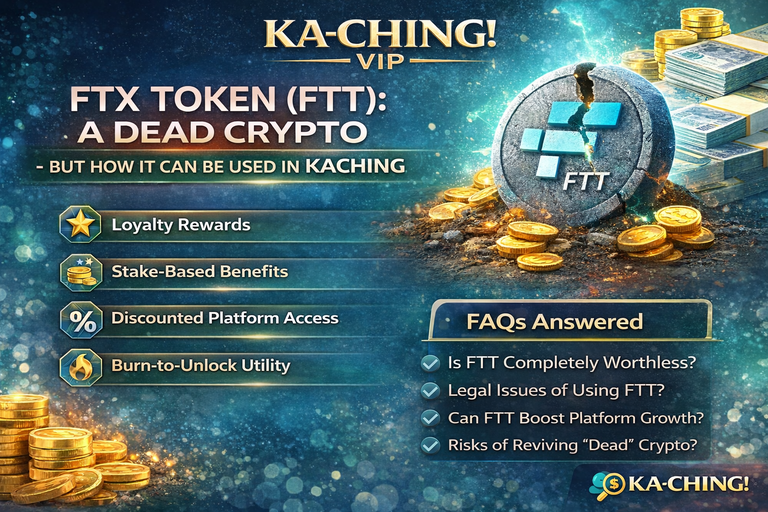
When FTX collapsed in November 2022, it didn’t just shake the cryptocurrency market it shattered trust. At the center of that collapse was FTX Token (FTT), once a top-tier exchange token used for fee discounts, staking rewards, and ecosystem perks. Within days, FTT lost most of its value and became one of the most cited examples of crypto failure.
Years later, FTT is often labeled a “dead crypto.” But in blockchain markets, “dead” rarely means erased. Tokens continue to exist on-chain even after their original ecosystem collapses. That raises a practical question: can a legacy token like FTT still serve a purpose in a new framework such as KAching?
This article explores the facts, risks, and realistic possibilities.
What Made FTT Valuable Before the Collapse?
Before FTX filed for bankruptcy, FTT functioned as a utility token within the exchange ecosystem. Its core use cases included:
- Trading fee discounts
- VIP tier upgrades
- Staking-based rewards
- Token buybacks and burns
- Participation in platform launches
Like many exchange tokens, FTT’s value was directly tied to the performance and credibility of the FTX platform. When the exchange imploded, the utility that supported FTT’s valuation disappeared almost instantly.
Without a functioning ecosystem, the token lost its foundational support.
Why FTT Is Considered a “Dead Coin”
In crypto terminology, a dead coin usually has:
- No active development roadmap
- No functioning ecosystem
- Collapsed investor trust
- Minimal real-world application
FTT fits much of that description today. While still tradable on some exchanges, its original utility framework is gone. Its price action is largely speculative, disconnected from meaningful on-chain activity.
However, technical existence is not the same as functional relevance. Tokens can be repurposed but only under strict structural and legal considerations.

How FTT Could Potentially Be Used in KAching
If KAching were to explore integrating FTT, it would need a clearly defined, transparent utility model. Below are conceptual approaches not endorsements that illustrate how legacy tokens can sometimes be repositioned.
1. Loyalty or Engagement Rewards
FTT could be distributed as a non-core reward token for platform engagement, rather than serving as the primary value driver. This reduces dependency risk.
2. Discount Access Mechanism
Users holding FTT could unlock reduced service fees, premium features, or bonus access tiers similar to its original exchange-based utility but within a new environment.
3. Staking-Based Participation
FTT could be used in a limited staking model where holders receive platform-specific benefits, such as multiplier bonuses or governance voting privileges.
4. Burn-to-Unlock Model
A structured burn mechanism where FTT must be permanently removed from circulation to unlock access features could introduce controlled utility while limiting supply exposure.
Any of these approaches would require legal clarity, financial transparency, and clear separation from the legacy FTX structure.
Major Risks of Integrating a Collapsed Token
Repurposing FTT is not a simple branding exercise. It carries measurable risks:
- Reputational Risk: FTX remains one of the largest crypto scandals in history.
- Regulatory Complexity: Ongoing bankruptcy proceedings could affect legal treatment.
- Volatility Risk: FTT price swings remain unpredictable.
- Liquidity Concerns: Exchange listings and trading volume are limited compared to peak levels.
For any platform, especially one building long-term credibility, these factors cannot be ignored.
The Bigger Lesson for Crypto Platforms
FTT’s collapse highlights a key principle: tokens derive value from trust, governance, and sustainable utility — not from branding alone.
When utility disappears, price typically follows.
That said, blockchain technology allows tokens to outlive failed companies. The real challenge is rebuilding credible utility around them without repeating past structural flaws.
A modern platform considering legacy tokens must focus on:
- Independent governance
- Transparent token economics
- Legal compliance
- Clear risk disclosure
- Sustainable use cases
Without these elements, integration becomes speculation rather than innovation.
Can a “Dead Crypto” Be Revived?
History shows that while full recoveries are rare, selective repurposing is possible under new leadership and new rules.
But revival requires more than market momentum. It requires:
- Structural redesign
- Community rebuilding
- Clear differentiation from past failures
- Responsible financial management
Otherwise, the label “dead coin” becomes permanent.
(FAQs)
1. Is FTT completely worthless today?
No. FTT still trades on certain exchanges, meaning it retains market value. However, that value is highly speculative and no longer tied to its original ecosystem.
2. Would integrating FTT automatically improve a platform’s growth?
Not necessarily. Token integration only adds value if the underlying platform has strong fundamentals and clear utility.
3. Are there legal barriers to using FTT in a new ecosystem?
Potentially yes. Legal evaluation is essential due to FTX bankruptcy proceedings and evolving global crypto regulations.
4. Is using a legacy token riskier than launching a new one?
Often yes. A new token allows for clean tokenomics and branding, while a legacy token carries historical and reputational baggage.