
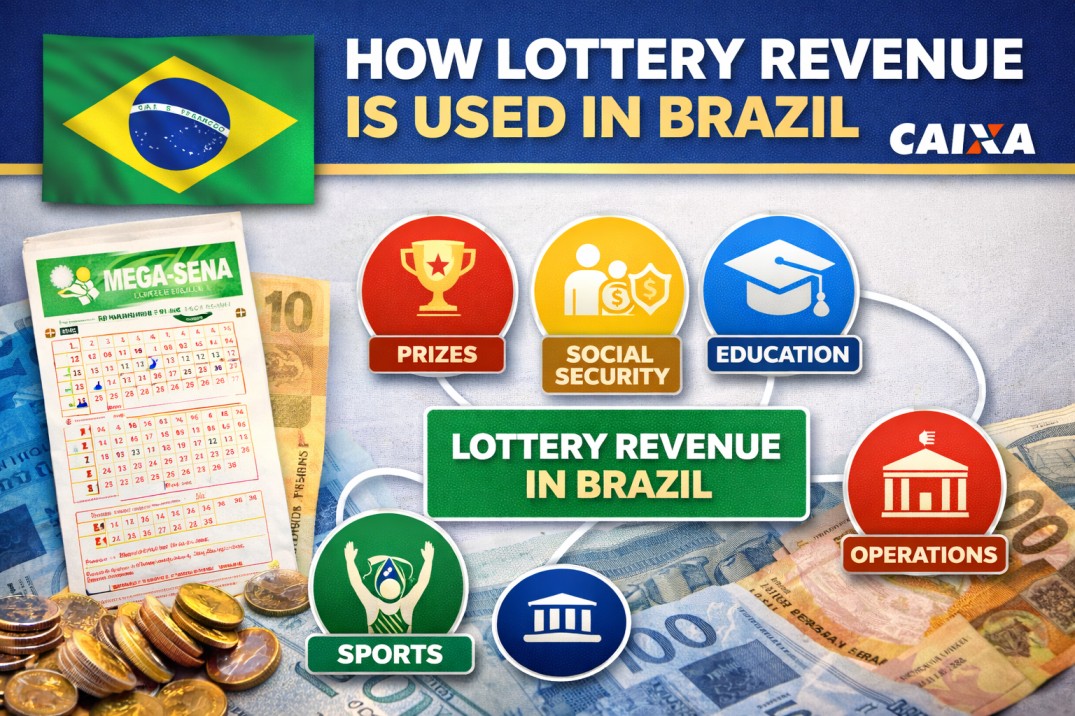
When people in Brazil buy a Mega-Sena lottery ticket, most assume the money goes into one thing.
The jackpot.
In reality, that ticket price is already split into multiple streams long before the draw happens. Brazil’s lottery is not just a game system. It is a public revenue distribution system, designed by law.
Understanding where the money goes explains why Brazil protects its lottery structure so fiercely.
Who Runs the Lottery in Brazil
Brazil’s national lotteries, including Mega-Sena, are operated by Caixa Econômica Federal, a government-owned bank.
This matters.
Because unlike private lottery operators, Caixa is legally required to route lottery revenue into specific public funds. The allocations are not optional, and they are not hidden.
How Mega-Sena Lottery Revenue Is Split
For every Mega-Sena ticket sold, revenue is divided into four broad buckets.
1. Prize Money (Around 45–46 Percent)
This includes:
- The jackpot
- Secondary prizes for matching 4 or 5 numbers
- Fixed prize tiers
Less than half of the ticket price actually goes to winners. This is standard for large national lotteries, though many players assume the number is higher.
2. Social Security and Welfare Programs
A significant share of lottery revenue in Brazil is legally directed to social security and welfare funds.
These funds support:
- Pension-related systems
- Assistance programs for vulnerable populations
- Long-term social insurance obligations
This is one reason lottery revenue is politically sensitive. Removing it would create funding gaps elsewhere in the state.
3. Education Funding
Lottery revenue in Brazil also supports education financing, including:
- Basic education programs
- Higher education infrastructure
- National education funds tied to public spending mandates
This allocation is automatic. It does not depend on annual budget negotiations.
In simple terms, lottery sales quietly subsidise parts of Brazil’s education system.
4. Sports and Olympic Development
Brazil is one of the few countries where lottery revenue is explicitly tied to sports funding.
Funds are used for:
- Olympic and Paralympic athlete development
- Training centres and national teams
- Grassroots sports programs
When Brazilian athletes compete internationally, part of that journey is often funded by lottery money.
Administration, Retailers, and Operations
Not all non-prize money goes to public programs.
A portion is used for:
- Retailer commissions
- Lottery operations
- Auditing and compliance
- Draw infrastructure and technology
Brazil still relies heavily on physical lottery draws, which require ongoing operational costs.
Why Brazil Uses This Model
Brazil’s lottery revenue model exists for three reasons:
- It generates large, predictable cash flows
- It funds politically important programs without raising taxes
- It spreads funding responsibility across voluntary participation
The lottery becomes a financial buffer for the state.
Jackpots attract attention.
Allocations protect legitimacy.
Is Lottery Revenue Regressive in Brazil?
Yes. And Brazil does not deny this.
Lower-income households spend a higher percentage of their income on lottery tickets. That money is then redistributed into public services that also disproportionately serve lower-income populations.
Whether this trade-off is fair is a political question.
But the system is transparent about what it is doing.
How Brazil’s Lottery Revenue Model Compares Globally
Compared to other countries:
- The United States often directs lottery revenue mainly to education, with variation by state
- Some countries allow private operators with looser allocation rules
- Brazil hardcodes allocations into law and centralises control
This makes Brazil’s system stable but rigid.
What This Means for the Future of Lotteries
Any new lottery model in Brazil, including digital or on-chain systems, would need to answer one question first:
Who replaces the public funding?
Until that question has a credible answer, Brazil’s lottery structure is unlikely to change significantly.
The Bottom Line
In Brazil, lottery revenue is not just about winning money.
It is about:
- Financing education
- Supporting social security
- Funding national sports
- Keeping parts of the state running quietly
Every Mega-Sena ticket is doing more work than most players realise.
And that is exactly how the system is designed to function.
FAQs: How Lottery Revenue Is Used in Brazil
1. Where does Brazil’s lottery money actually go?
Roughly 45 – 46 percent goes to prizes, while the rest is legally distributed to social security, education, sports development, operations, and retailer commissions.
2. Who controls and allocates lottery revenue in Brazil?
Allocation is defined by federal law and administered by Caixa Econômica Federal, Brazil’s state-owned lottery operator.
3. Is Brazil’s lottery revenue used for public programs?
Yes. Lottery funds support education financing, social security systems, and Olympic and Paralympic sports programs, among other public initiatives.
4. Why doesn’t Brazil privatise its lottery system?
State control ensures stable, predictable funding for public programs. Privatisation would risk disrupting those revenue flows.
5. Could digital or crypto lotteries replace Brazil’s system?
Not without replacing the same public funding streams. Any alternative must match the lottery’s role as a government revenue mechanism, not just a game.