
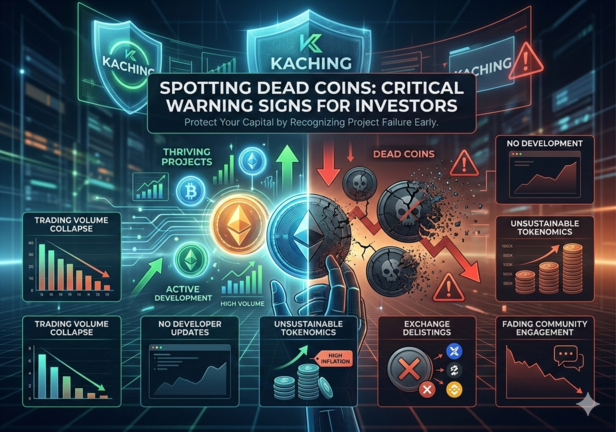
The cryptocurrency market is known for explosive growth stories. But behind the headlines of record-breaking gains lies a quieter reality: thousands of projects eventually fail. Many so-called “dead coins” do not collapse without warning. They leave clear signals long before the final crash.
Understanding how to identify those warning signs can help investors protect capital, reduce risk, and avoid being trapped in illiquid assets.
This guide breaks down the key indicators that a cryptocurrency may be heading toward failure.
What Is a Dead Coin?
A dead coin is a cryptocurrency project that has lost meaningful development activity, community engagement, liquidity, or real-world utility. Some fail gradually due to neglect. Others collapse suddenly after hacks, regulatory issues, or insider sell-offs.
Not every declining coin is dead. However, most failed projects show consistent red flags before becoming worthless.

10 Early Warning Signs of a Dead Coin
| Warning Sign | What It Indicates | Why It Matters |
|---|---|---|
| Sharp drop in trading volume | Fewer buyers and sellers | Harder to exit positions |
| No developer updates | Abandoned or inactive project | Weak long-term prospects |
| Repeated roadmap delays | Poor execution | Loss of credibility |
| Token inflation | Excess supply creation | Price dilution risk |
| Team stops communicating | Transparency issues | Investor uncertainty |
| Exchange delistings | Reduced market access | Liquidity collapse |
| No working product | Speculation only | Weak demand foundation |
| Large wallet sell-offs | Insider exits | Price pressure |
| Unresolved security issues | Vulnerability risk | Trust erosion |
| Community inactivity | Declining interest | Loss of momentum |
When multiple warning signs appear together, the probability of long-term decline increases significantly.
1. Trading Volume Collapse
Price can remain stable temporarily, but if daily trading volume declines sharply, liquidity becomes a serious issue. Low liquidity increases volatility and makes it difficult for investors to sell without causing major price impact.
Healthy projects maintain consistent trading activity even during market downturns.
2. Developer Activity Is Critical
A cryptocurrency project depends on continuous technical development. Inactive repositories and long gaps between updates suggest abandonment.
Before investing, review:
- Public code repositories
- Update frequency
- Development milestones
- Transparency reports
Marketing activity without technical progress is often a warning sign.
3. Unsustainable Tokenomics
Many projects collapse because their token supply grows faster than demand.
Common risks include:
- Unlimited token minting
- Excessively high staking rewards with no revenue backing
- Large insider token unlocks scheduled in the near future
If supply expands while adoption remains stagnant, long-term price pressure becomes likely.
4. Exchange Delistings
When major exchanges remove a coin due to low volume, compliance concerns, or inactivity, liquidity declines immediately. Reduced exchange presence limits accessibility and damages credibility.
Once delisted from major platforms, recovery becomes difficult.
5. Fading Community Engagement
Strong projects are supported by active communities. A noticeable drop in discussion forums, social media activity, and governance participation often signals declining interest.
When engagement falls, new capital inflows typically decline as well.
The Typical Collapse Pattern
Many failed projects follow a similar cycle:
- Aggressive marketing and hype
- Rapid price surge
- Slowing development progress
- Declining liquidity
- Insider sell-offs
- Exchange delistings
- Price crash
Recognizing this pattern early can significantly reduce investment risk.
How to Protect Yourself
To reduce exposure to failing projects:
- Research the development team and their track record
- Review token supply mechanics and vesting schedules
- Monitor developer activity regularly
- Check exchange listings and liquidity levels
- Avoid unrealistic annual percentage yield promises
- Diversify investments to manage risk
Risk management remains essential in a highly volatile market.
FAQ’s About Crypto Dead Coins
1. Can a dead coin recover?
Recovery is rare but not impossible. Some projects restructure or merge with stronger ecosystems. However, most dead coins do not return to previous price levels.
2. How can I verify developer activity?
You can review public code repositories such as GitHub to check commit frequency, active contributors, and open development issues.
3. Does a low price mean a coin is dead?
No. Many strong projects experience price declines during market downturns. Viability depends on fundamentals, not price alone.
4. What is the difference between a scam coin and a dead coin?
A scam coin is intentionally created to defraud investors. A dead coin may have started legitimately but failed due to poor execution, lack of funding, or market conditions.