
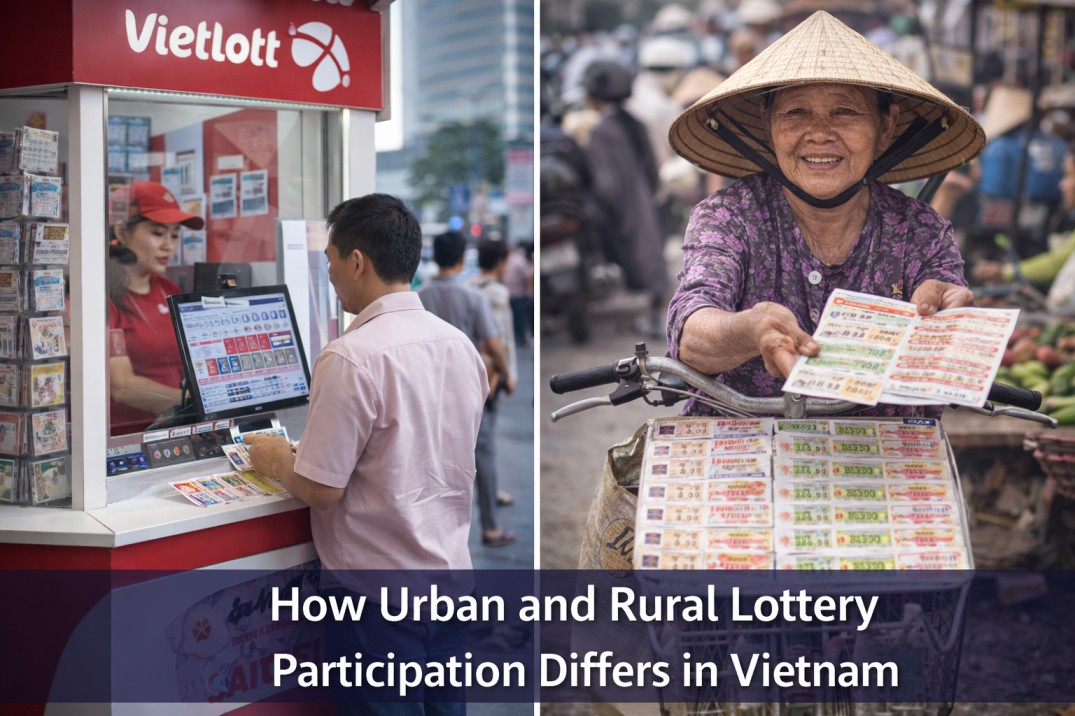
How Urban and Rural Lottery Participation Differs in Vietnam
Lottery participation in Vietnam looks uniform on the surface, but in reality, urban and rural players behave very differently. The difference is not just about income. It is about access, trust, habits, and what people expect from the lottery.
Understanding this gap explains why certain lottery games grow faster in cities, while traditional tickets remain dominant in villages.
The Structure of Vietnam’s Lottery System
Vietnam operates a dual lottery system.
- Traditional regional lotteries, sold daily through paper tickets
- Centralized digital lotteries, operated by Vietlott
Both are legal, state-run, and widely accepted. But who plays what depends heavily on geography.
Urban Lottery Participation in Vietnam
In cities like Ho Chi Minh City, Hanoi, and Da Nang, lottery play has become more transactional and technology-driven.
What Urban Players Prefer
Urban participants increasingly favor:
- Vietlott games with large advertised jackpots
- Fixed draw schedules
- App-based or terminal-based ticket purchases
- Clear, centralized result announcements
Many urban players see the lottery as:
- A form of low-cost entertainment
- A mathematical odds game
- A digital transaction, not a social ritual
Urban participation spikes when jackpots grow large or when international-style games are promoted.
How Urban Players Buy Tickets
Urban buyers usually:
- Purchase tickets at malls, convenience stores, or kiosks
- Check results online or through apps
- Play irregularly, driven by jackpot size
For them, the lottery competes with other spending choices like food delivery, OTT subscriptions, or gaming apps.
Rural Lottery Participation in Vietnam
In rural Vietnam, lottery play is deeply human and habitual.
The Role of Lottery Sellers
Traditional lottery tickets are often sold by:
- Elderly vendors
- People with disabilities
- Door-to-door sellers on bicycles
For rural buyers, purchasing a lottery ticket is also seen as supporting livelihoods, not just gambling.
This emotional connection is critical.
How Rural Players Think About the Lottery
Rural participants tend to:
- Play small amounts regularly
- Buy the same numbers repeatedly
- Trust familiar sellers over institutions
- Value paper tickets they can hold
Lottery play becomes part of daily life, not a special event.
Trust: Institutions vs People
This is the biggest dividing line.
- Urban players trust systems
- Rural players trust people
Urban buyers are comfortable trusting a digital terminal or app. Rural buyers prefer buying from someone they know and see every day.
This explains why Vietlott adoption is slower in rural regions, despite national advertising.
Income Is Not the Real Divider
Contrary to assumptions, income is not the main factor.
Rural players often spend:
- Smaller amounts
- More consistently
Urban players:
- Spend sporadically
- Increase spending during large jackpot cycles
Both groups participate actively, but their risk behavior differs.
Result Consumption Is Also Different
Urban players:
- Check results online
- Follow jackpot news
- Track rollover stories
Rural players:
- Hear results from sellers or local radio
- Check printed boards
- Ask others
Information flows differently, and lottery communication must adapt to this.
Why Traditional Lotteries Still Dominate Rural Vietnam
Despite digital expansion, traditional lotteries remain dominant in rural areas because:
- They are familiar
- They support local sellers
- They require no technology
- They fit daily routines
This makes them resilient, even as digital options grow.
What This Means for Vietnam’s Lottery Future
Vietnam’s lottery growth will not come from replacing rural habits with urban ones.
It will come from:
- Gradual digital trust-building
- Hybrid models that respect human sellers
- Clear communication in local contexts
Ignoring this divide risks slowing adoption instead of accelerating it.
FAQs – Vietnam Lottery Participation
Is Vietlott more popular in cities or villages
Vietlott is more popular in urban areas, while traditional lotteries dominate rural regions.
Why do rural players prefer traditional lottery tickets
Because they trust familiar sellers, value paper tickets, and see the purchase as social support.
Do rural players spend less on lottery tickets
They usually spend smaller amounts but do so more regularly.
Will digital lotteries replace traditional ones in Vietnam
Unlikely in the near future. Both systems serve different social and economic roles.
Who regulates lotteries in Vietnam
Vietnam’s lotteries are state-run and regulated under government oversight, including Vietlott for digital games.
Editorial Verdict
Vietnam’s lottery divide is not about modern versus backward.
It is about how people relate to risk.
Cities turn the lottery into a transaction.
Villages turn it into a relationship.
Any lottery strategy that ignores this difference will fail quietly.