
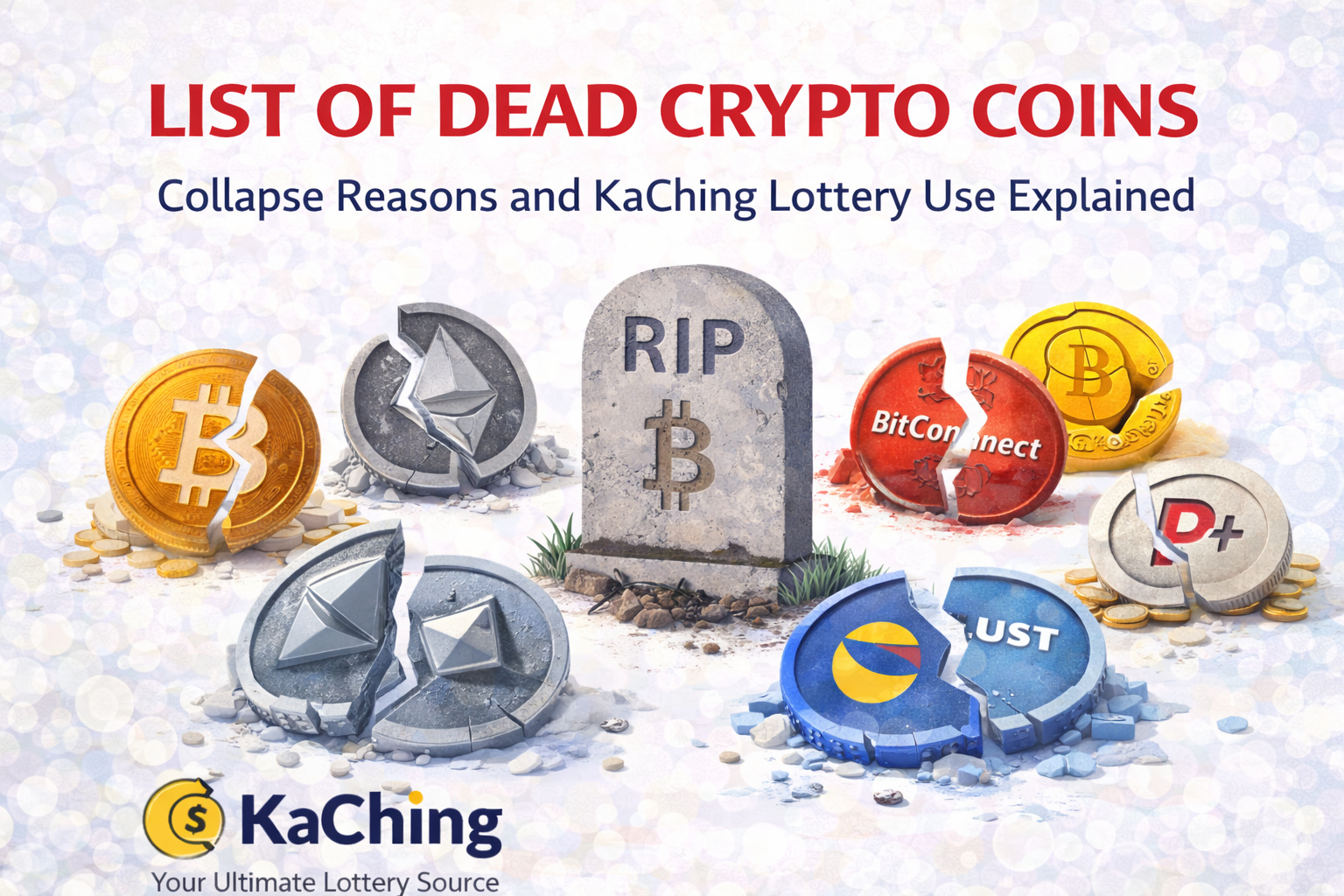
Cryptocurrency markets are famous for fast rises – and spectacular collapses. Behind today’s headlines about blue-chip tokens there’s a long trail of projects that failed, were exposed as scams, or simply faded when liquidity dried up. Below is a journalist-style roundup of notable “dead” crypto projects, how and why they failed, what happened to their users, and crucially whether those tokens can be used with a lottery brand like KaChing.
List of Dead Crypto Coins
- BitConnect – Ponzi / lending token that collapsed in 2018.
- OneCoin – Large pyramid/Ponzi fraud; key figures prosecuted; token never had a real blockchain.
- PlusToken – Wallet / scam that stole billions and liquidated coins to crash prices.
- The DAO – Code vulnerability led to a huge heist in 2016 and the effective end of the DAO token; Ethereum hard-fork followed.
- Terraform Labs (Terra) (LUNA / UST collapse) – A major 2022 collapse that wiped out tens of billions in value and led to legal action against founders.
(There are many more “zombie” tokens and delisted projects – CoinGecko and market research teams estimate millions of tokens launched over recent years with a majority inactive or abandoned).
How Each Crypto Coin died
BitConnect – hype, lending promises, and a sudden shutdown
BitConnect marketed a high-yield lending product tied to a proprietary trading bot. Rapid investor inflows and aggressive promotions created a bubble. Regulators and researchers later called it a Ponzi; exchanges delisted the token and the lending platform closed, leaving retail holders with worthless tokens. Legal actions and regulatory suits followed.
OneCoin – the textbook pyramid that never had a blockchain
OneCoin operated like a multi-level marketing (MLM) scheme: members bought “educational” packages and were told tokens would appreciate. But OneCoin never used a public blockchain – it was a ledger controlled centrally by the operators. Global law enforcement dismantled parts of the operation; several people were convicted, though some founders still evade capture.
PlusToken – a wallet scam that drained liquidity
PlusToken promised wallet services and high returns. Operators moved huge sums into a small set of addresses, and their liquidation activity in 2019-2020 is blamed for downward pressure on major cryptocurrencies. After arrests, many victims found their funds unrecoverable.
The DAO – code vulnerability and a blockchain split
The DAO was an early experiment in decentralized funds management. A smart-contract exploit allowed an attacker to drain millions of dollars’ worth of ETH. The Ethereum community chose a hard fork to reverse the theft, effectively ending The DAO and leading to the separate Ethereum Classic chain. This was a technical failure rather than fraud, but it rendered The DAO token defunct.
Terra (LUNA / UST) – algorithmic stablecoin breakdown and contagion
Terra’s model relied on an algorithmic peg between UST (the stablecoin) and LUNA (the balancing token). When the peg failed in May 2022, both assets collapsed in value almost overnight, wiping out retail and institutional holders and spurring lawsuits and prosecutions of key figures. The episode highlighted the systemic risks of fragile, interdependent tokenomics.
What happened to users who held these tokens?
Outcomes varied:
- Total loss: In Ponzi or exit-scam cases (BitConnect, OneCoin, PlusToken), many retail holders lost most or all of their money.
- Partial recovery through legal action: Prosecutors sometimes seize funds and restitute victims, but recoveries are rare and slow.
- Technical fallout: Projects like The DAO forced technical fixes (hard forks) that changed token economics and value, often leaving original token holders with worthless or different assets.
Across the board, the lesson is the same: liquidity and verifiable infrastructure (active markets and public blockchain) matter. When either disappears, tokens become functionally “dead.”
Can “dead” crypto coins be used with KaChing lottery?
Generally no. Dead, delisted, or scam tokens are not practical as payment rails for a consumer service like KaChing. Here’s why:
- Liquidity and acceptance: Lotteries and payment processors require reliably convertible assets (fiat or widely-listed cryptocurrencies). Dead tokens are typically delisted from exchanges or only trade on obscure markets – making conversion or valuation impossible.
- Legal and compliance risks: Using tokens associated with fraud or that lack on-chain provenance can expose a platform to anti-money-laundering (AML) and regulatory risk. Reputable operators avoid dubious tokens.
- Technical infeasibility: Some “tokens” were never on a public blockchain (e.g., OneCoin). Those are ledger entries controlled by operators – they have no transferability in public markets.
So even if someone still holds a “dead” token in a private wallet, KaChing could not reasonably accept it as payment or to stake for a lottery ticket unless the token is converted to an accepted currency first – and conversion is often impossible.
How could KaChing work with crypto safely, without touching dead tokens?
If KaChing plans to accept crypto, best practices are:
- Accept only liquid, reputable cryptocurrencies (e.g., major tokens listed on regulated exchanges).
- Use a regulated payment processor / crypto gateway to handle conversion and AML/KYC checks.
- Disallow deposits in delisted or unverified tokens; provide clear guidance that users must convert obscure tokens to accepted currency before use.
- Document a provenance check: insist tokens used for deposits be from verifiable on-chain sources and not linked to known scams.
This approach protects the platform and its customers – and avoids legal and reputational risk.
Practical note for users holding dead tokens who want to play KaChing
- Attempt conversion first: If the token is still listed on any exchange, convert to a liquid asset (stablecoin or fiat) via an established exchange, then deposit.
- If token is delisted / untradeable: value is effectively zero for commercial use. Professional recovery often involves legal action not an easy path for small holders.
- Never try to “send” an obscure token directly to a service – the platform may not support the blockchain or token contract and funds will be lost.
The “dead coin” phenomenon is a reminder that token markets are not a substitute for transparent governance, real utility, and regulatory safeguards. For businesses like KaChing that care about customer trust and longevity, accepting only well-supported, liquid assets and enforcing strict compliance is the practical route. For individual holders, the safest strategy is to stick with well-established assets and to treat any too-good-to-be-true yield promises with skepticism.
FAQs
1. Can a dead token ever come back to life?
Yes sometimes a dormant project is revived by a new development team, a community fork, or relisting on exchanges. But revival requires credible governance, liquidity, and community trust; it’s rare.
2. Are holding or trading dead tokens taxable?
Tax rules vary by jurisdiction. In many places, disposal or conversion of any crypto (even low-value tokens) is a taxable event. Consult a tax professional but don’t assume “dead” means tax-free.
3. Can platforms legally accept tokens linked to scams if the holder proves provenance?
Even with provenance, platforms face AML and regulatory scrutiny. Most regulated platforms will refuse tokens tied to known frauds until legal clearances occur.
4. Where can I check if a token is “dead” or delisted?
Use reputable market aggregators (CoinGecko, CoinMarketCap), check exchange listings, and read official community channels. If a token has zero 24-hour volume, no exchange listings, or no active developer updates, treat it as effectively dead.