
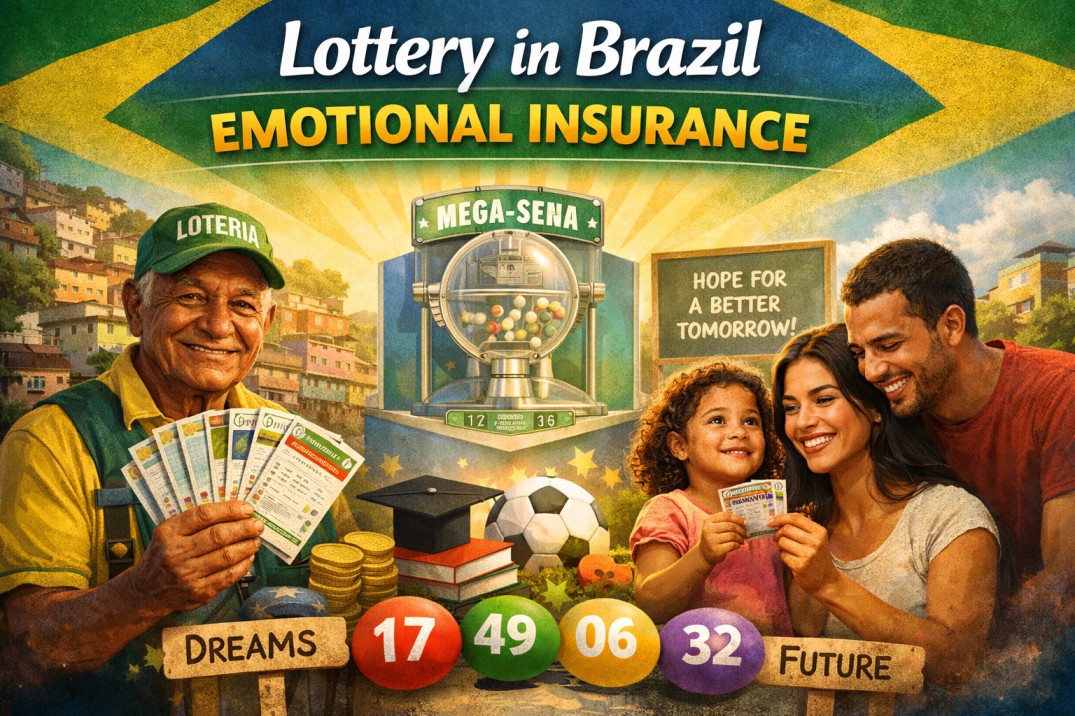
In many countries, the word lottery immediately triggers the word gambling. In Brazil, that logic does not fully apply.
For millions of Brazilians, lottery tickets are not about addiction, thrill, or reckless risk. They are about emotional survival. They are about buying a small piece of hope in an economy where certainty is rare and social mobility is slow.
This is why calling Brazil’s lottery system gambling is technically correct, but emotionally wrong.
This is a feature story about why lottery in Brazil functions more like emotional insurance than a betting habit.
The Brazil Reality Most Global Analysts Miss
Brazil is not a poor country. It is also not an equal one.
More than 60 percent of Brazilians live paycheck to paycheck. Informal work is common. Inflation eats savings. Government welfare exists but is limited and slow.
In this environment, people do not gamble to get rich fast. They buy hope to stay sane.
A lottery ticket in Brazil usually costs less than a bus ride. For many families, that ticket represents one powerful idea.
“What if tomorrow is different?”
That single thought is worth far more than the ticket price.
The State, Not the Mafia, Runs the Lottery
This matters.
Brazil’s national lottery system is run by Caixa Econômica Federal, a government-owned financial institution.
The most popular lottery, Mega-Sena, is not positioned as a casino game. It is positioned as a public system.
Here is the emotional logic at play.
- The government runs it
- The money funds education, sports, and social programs
- The draw is public and televised
- The ticket seller is often a trusted local vendor
This does not feel like gambling. It feels like participation.
Emotional Insurance Explained in Simple Terms
Insurance is something you buy not because you expect to use it, but because it protects your mind.
Health insurance does not guarantee health.
Life insurance does not guarantee life.
Lottery in Brazil works the same way.
People know they will probably not win. But they also know that not playing guarantees nothing changes.
So they buy one ticket. Sometimes two. Rarely more.
Not to escape reality, but to emotionally soften it.
Case Study. The Favela Household Logic
Let us break this down using a real-world behavioral pattern observed across Brazilian urban communities.
A family earning a low but steady income sets aside small money every month.
- Food is fixed
- Rent is fixed
- Transport is fixed
- Lottery is flexible but consistent
Why?
Because the lottery ticket is the only expense in that list that represents upside.
Everything else is survival. Lottery is imagination.
Why This Is Different From Western Gambling Culture
In the US or Europe, gambling is driven by adrenaline.
- Casinos
- Sports betting
- High frequency plays
- Instant wins and losses
In Brazil, lottery behavior is slow.
- Weekly draws
- Low ticket volumes
- Long conversations around numbers
- Family discussions before buying
This is not dopamine gambling. This is narrative gambling.
People are not chasing the rush. They are sustaining a story.
Data That Supports the Emotional Theory
Brazil has one of the highest lottery participation rates among low and middle income groups.
Yet Brazil does not show proportional spikes in gambling addiction compared to casino-heavy markets.
Why?
Because lottery in Brazil is not engineered for speed.
Speed creates addiction.
Waiting creates hope.
Mega-Sena draws happen twice a week. That gap matters psychologically.
The Government’s Silent Understanding
Brazil’s government understands something most regulators ignore.
If you remove emotional hope from stressed populations, they will seek it elsewhere.
Often in far worse systems.
So instead of fighting the emotion, Brazil structured it.
- Transparent odds
- Public draws
- Social funding narratives
- Low entry cost
This turns a risky behavior into a socially absorbed one.
Why Crypto Lotteries Resonate Strongly in Brazil
This is where modern platforms need to pay attention.
Brazil has high crypto adoption.
Brazil has lottery culture.
Brazil trusts transparent systems when explained well.
That is not coincidence.
A provably fair system, visible draws, and community participation align perfectly with Brazil’s emotional insurance mindset.
The moment crypto lotteries start speaking hope instead of hype, Brazil listens.
The Mistake Most Global Brands Make
They market lottery as “win big fast”.
That message works in the US.
It fails in Brazil.
The correct message is not wealth.
The correct message is dignity.
- A chance
- A story
- A reason to imagine tomorrow
That is emotional insurance.
Final Thought. Hope Is an Economic Tool
Economists measure GDP.
Marketers measure conversion.
Politicians measure votes.
But societies run on hope.
Brazil’s lottery system quietly monetizes hope without letting it turn toxic.
That is not gambling culture.
That is emotional infrastructure.
And until global analysts understand that, they will keep misreading Brazil.
FAQs. Lottery in Brazil as Emotional Insurance
Is lottery legal in Brazil?
Yes. Lottery in Brazil is completely legal and regulated by the government through Caixa Econômica Federal. All major national lottery games are operated by the state, not private casinos or underground networks.
Is lottery considered gambling in Brazil?
Legally, yes. Emotionally and culturally, no.
For most Brazilians, lottery participation is not about thrill or addiction. It is about hope, stability, and imagining a better future in an uncertain economy.
Why do so many low and middle income Brazilians play the lottery?
Because it is affordable emotional relief.
A lottery ticket costs very little but offers something rare for many households: the feeling that tomorrow could be different. That psychological comfort matters more than the odds.
What is the most popular lottery in Brazil?
The most popular lottery is Mega-Sena. It has nationwide participation, public draws, and large jackpots, but most players buy only one or two tickets per draw.
Do Brazilians expect to win the lottery?
Most do not.
People understand the odds are low. They play knowing they may never win. The value is not expectation. The value is imagination and emotional balance.
I really like how you frame the lottery as a kind of emotional buffer rather than just a financial bet. In a system where upward mobility feels out of reach, buying a ticket becomes less about winning and more about momentarily feeling that change is possible. It’s a perspective that helps explain why the lottery remains so culturally ingrained even when the odds are stacked against everyone.