
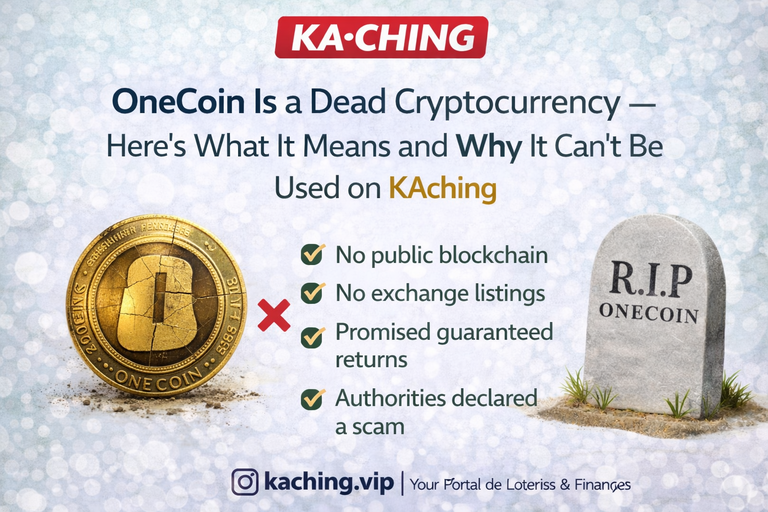
For years, OneCoin was marketed as the next big thing in cryptocurrency a revolutionary digital asset that would rival Bitcoin. Today, however, OneCoin is widely recognized by regulators and financial authorities around the world as one of the largest crypto-related frauds in history.
Despite this, questions still surface online: Is OneCoin still active? Can it be used on platforms like KAching? Does it have any value left?
The short answer is clear: OneCoin is not a functioning cryptocurrency and cannot be used on legitimate financial or crypto platforms, including KAching.
Here’s what investors need to understand.
What Was OneCoin?
Launched in 2014, OneCoin claimed to be a cryptocurrency built on blockchain technology. It attracted millions of participants globally through aggressive multi-level marketing (MLM) campaigns.
However, investigations later revealed critical red flags:
- No verifiable public blockchain
- No transparent transaction records
- No legitimate crypto exchange listings
- Internal price manipulation
Authorities in multiple countries concluded that OneCoin operated as a large-scale financial scam rather than a real decentralized cryptocurrency.
Why OneCoin Is Considered “Dead”
Unlike legitimate cryptocurrencies such as Bitcoin or Ethereum, OneCoin never had:
- A public blockchain
- Independent node verification
- Open-source code
- Real market trading
Once regulatory crackdowns intensified and key figures behind the project were arrested or charged, the system effectively collapsed. Today, OneCoin does not trade on recognized exchanges and holds no measurable market liquidity.
In crypto terminology, a “dead coin” typically refers to a project that has lost development, liquidity, and community support. In OneCoin’s case, it goes further experts argue it was never a real cryptocurrency to begin with.

Can OneCoin Be Used on KAching?
No. KAching and other legitimate crypto or finance platforms operate only with verified, tradable digital assets that:
- Exist on public blockchains
- Have real-time market pricing
- Are listed on recognized exchanges
- Meet compliance standards
Because OneCoin does not meet any of these criteria, it cannot be deposited, traded, or used in any legitimate ecosystem.
If any third-party service claims to accept or convert OneCoin, extreme caution is advised.
Why This Still Matters Today
Even years after its collapse, OneCoin remains a cautionary tale in the cryptocurrency industry. It highlights key risks investors should watch for:
- Projects without transparent blockchain verification
- Guaranteed return promises
- Lack of exchange listings
- Closed, internal trading systems
The rapid growth of digital assets has made due diligence more important than ever.
Protecting Yourself From Similar Schemes
The OneCoin case underscores a simple rule: If you cannot independently verify a blockchain and market liquidity, it is not a legitimate cryptocurrency.
Before investing in any digital asset:
- Check if it is listed on reputable exchanges.
- Verify blockchain transparency via block explorers.
- Research regulatory warnings.
- Avoid guaranteed profit promises.
Crypto innovation continues to evolve but so do scams.
(FAQs)
1. Is OneCoin still tradable anywhere?
No recognized cryptocurrency exchange lists OneCoin. It does not have legitimate market trading activity.
2. Did OneCoin ever have a real blockchain?
Investigations concluded that OneCoin did not operate on a verifiable public blockchain.
3. Can investors recover funds lost in OneCoin?
Recovery depends on legal proceedings and jurisdiction. Some enforcement actions have occurred, but recovery is not guaranteed.
4. How can I verify if a cryptocurrency is legitimate?
Look for public blockchain explorers, exchange listings, transparent development teams, and regulatory compliance information.