
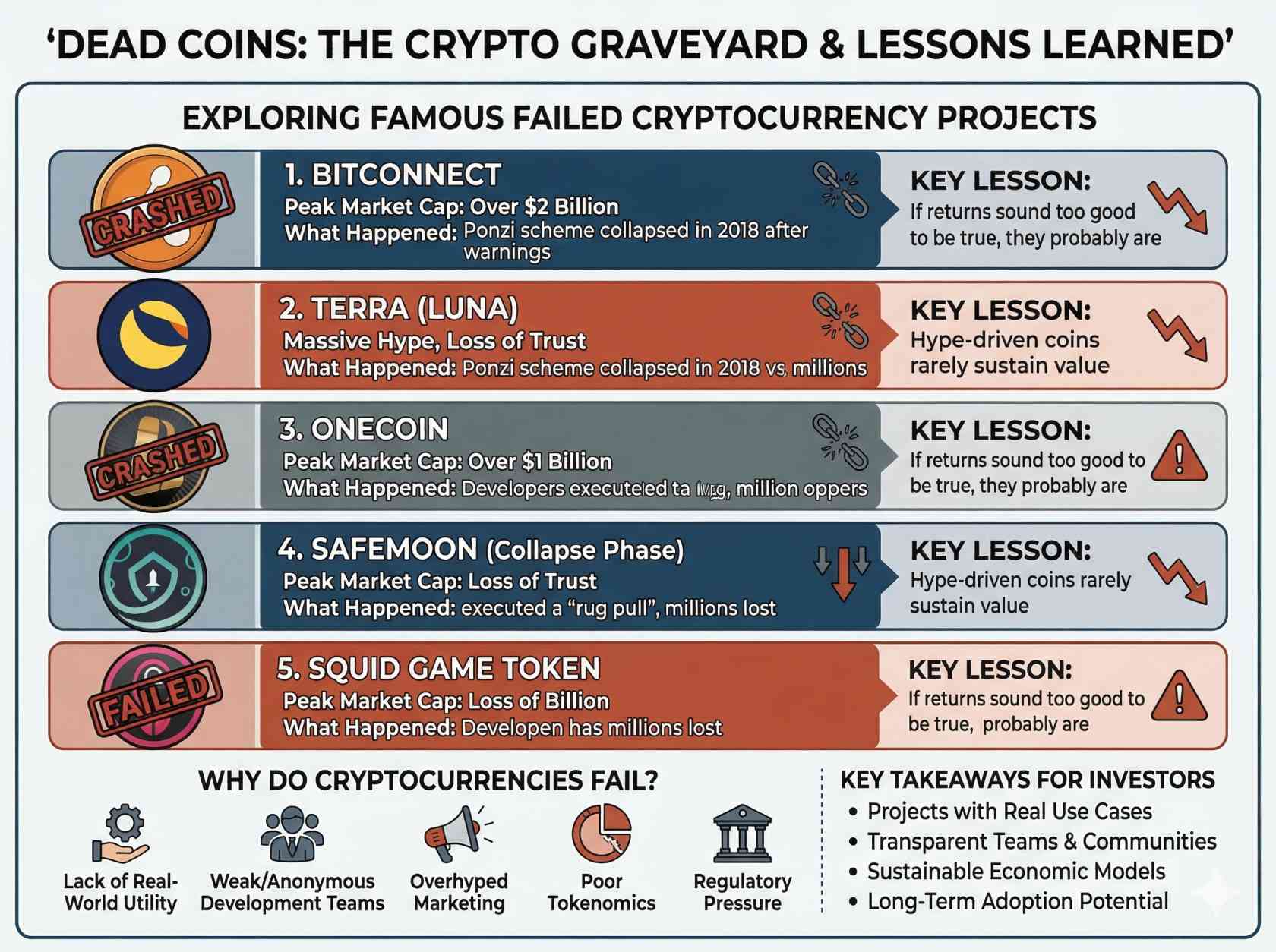
The cryptocurrency market has created billionaires, transformed finance, and introduced new technologies. But behind the success stories lies a graveyard of failed projects often called “dead coins.” These are cryptocurrencies that once showed promise but eventually collapsed due to poor fundamentals, scams, lack of adoption, or market shifts.
Understanding these failures is not just history. It is one of the smartest ways for investors to avoid costly mistakes in today’s fast-moving crypto space.
What Are Dead Coins in Crypto
Dead coins refer to cryptocurrencies that are no longer active, have no trading volume, or have been abandoned by developers. Some disappeared quietly, while others crashed dramatically, wiping out billions in investor value.

Most Famous Dead Coins and Their Collapse Stories
Here are some of the most well-known crypto failures that shaped the industry.
1. BitConnect
Once one of the most talked-about cryptocurrencies, BitConnect promised extremely high returns through a lending program. It quickly turned out to be a Ponzi scheme.
- Peak Market Cap: Over $2 billion
- What Happened: Collapsed in 2018 after regulatory warnings
- Key Lesson: If returns sound too good to be true, they probably are
2. Terra (LUNA)
Terra (LUNA) was one of the biggest crypto disasters in history.
- Peak Market Cap: Over $40 billion
- What Happened: Its stablecoin UST lost its peg in 2022
- Impact: Billions wiped out in days
- Key Lesson: Algorithmic stability is risky without strong backing
3. OneCoin
OneCoin never even had a real blockchain but managed to attract millions of investors globally.
- What Happened: Exposed as one of the largest crypto scams ever
- Founder: Ruja Ignatova (still missing)
- Key Lesson: Transparency and verifiable technology are essential
4. SafeMoon (Collapse Phase)
SafeMoon gained massive hype but struggled with long-term sustainability.
- What Happened: Declining value, legal issues, and loss of trust
- Key Lesson: Hype-driven coins rarely sustain value
5. Squid Game Token
Inspired by the popular Netflix series, this token surged rapidly before crashing.
- What Happened: Developers executed a “rug pull”
- Investor Losses: Millions lost overnight
- Key Lesson: Viral trends are not investment fundamentals
Dead Coins Overview Table
| Coin Name | Peak Value / Market Cap | Reason for Collapse | Investor Impact |
|---|---|---|---|
| BitConnect | $2B+ | Ponzi scheme | Massive losses |
| Terra (LUNA) | $40B+ | Stablecoin failure | Market shock |
| OneCoin | Billions raised | Fraud, no blockchain | Global scam |
| SafeMoon | Billions (peak hype) | Loss of trust, legal issues | Gradual decline |
| Squid Game Token | Millions | Rug pull | Instant crash |
Why Do Cryptocurrencies Fail
Dead coins are not random accidents. Most failures follow similar patterns:
- Lack of real-world utility
- Weak or anonymous development teams
- Overhyped marketing without substance
- Poor tokenomics or unsustainable models
- Regulatory pressure or legal issues
Recognizing these signs early can help investors avoid falling into the same traps.
What Investors Should Learn From Dead Coins
Crypto history shows that success is rare and failure is common. Smart investors focus on:
- Projects with real use cases
- Transparent teams and strong communities
- Sustainable economic models
- Long-term adoption potential
Instead of chasing quick profits, understanding risk is what separates successful investors from the rest.
FAQs About Most Famous Dead Coins in Crypto History
1. How can I check if a cryptocurrency is dead or inactive?
You can look at trading volume, developer activity on platforms like GitHub, and whether the project still has updates or community engagement.
2. Are all low-priced coins considered dead coins?
No, some low-priced coins are early-stage projects. A dead coin typically has no development, no liquidity, and no user activity.
3. Can a dead coin come back to life?
In rare cases, projects get revived, but most dead coins never recover due to loss of trust and support.
4. What is the biggest warning sign before a coin collapses?
Sudden price spikes driven purely by hype, combined with unclear fundamentals, are often a major red flag.