
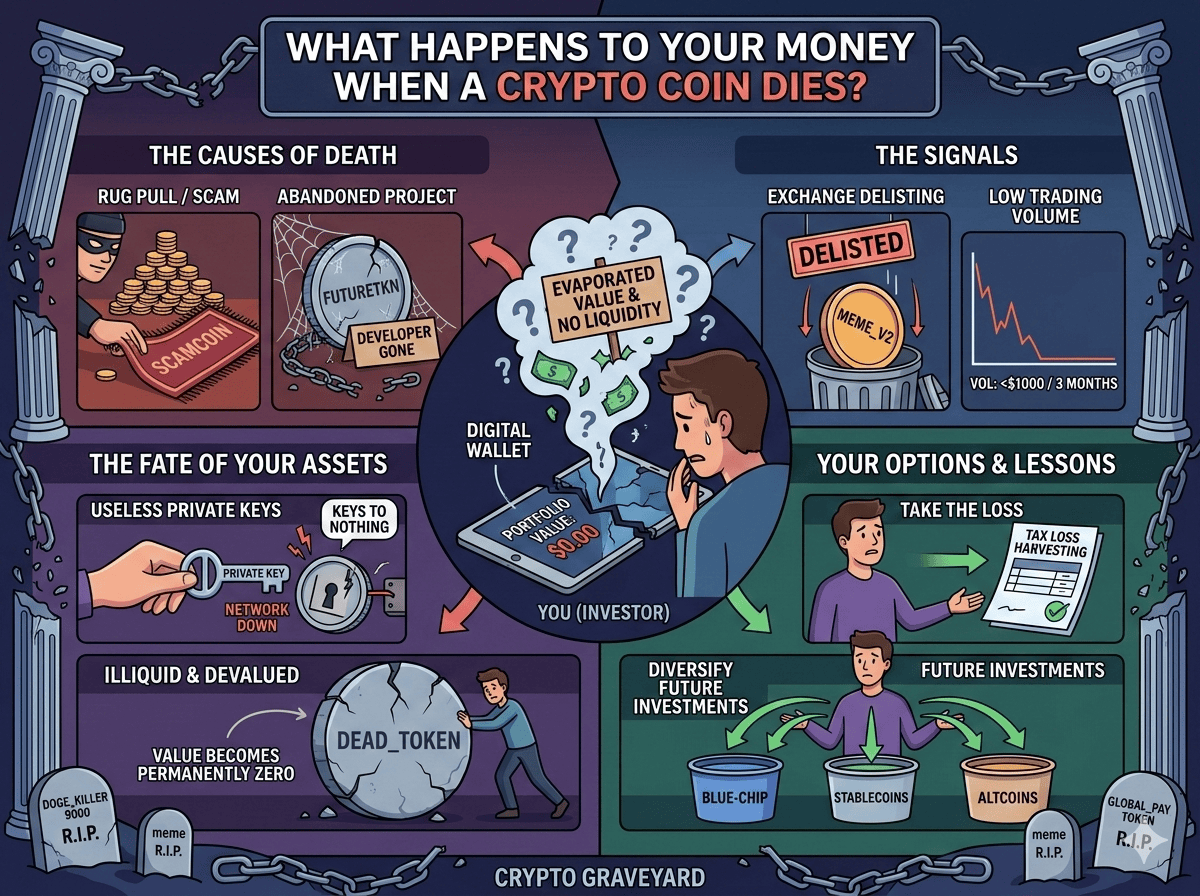
The world of cryptocurrency has created millionaires, transformed financial markets, and introduced new ways to invest. But alongside the success stories lies a harsh reality. Thousands of digital coins have disappeared, collapsed, or simply stopped functioning. For investors who held those tokens, the question becomes very real: what actually happens to your money when a crypto coin dies?
With thousands of projects launched over the past decade, not every cryptocurrency survives. Platforms tracked by organizations like CoinMarketCap and CoinGecko have recorded thousands of coins that are now inactive or abandoned.
Understanding what happens when a coin fails can help investors manage risk and avoid costly mistakes.
What Does It Mean When a Cryptocurrency Dies?
A cryptocurrency is generally considered dead when it loses liquidity, trading activity, development support, or community interest. In many cases, the project team disappears or stops updating the network.
When that happens, exchanges may remove the token from trading, wallets may stop supporting it, and its price can drop to nearly zero.
Some coins die gradually, while others collapse overnight due to hacks, scams, or economic failure.

What Happens to Your Money After a Coin Fails?
When a crypto project collapses, investors do not automatically get their money back. Cryptocurrency investments do not have the same protections as traditional financial assets.
Here are the most common outcomes.
1. The Token Value Drops to Near Zero
The most common scenario is that the coin simply loses value. If there are no buyers in the market, the token becomes nearly worthless.
Even though the tokens still exist in your wallet, they may have no practical value.
2. Exchanges Delist the Coin
When trading platforms determine that a project is inactive or risky, they often remove it from their listings. Exchanges such as Binance and Coinbase periodically review and delist tokens that no longer meet their standards.
Once delisted, selling the coin becomes extremely difficult because trading volume disappears.
3. Liquidity Completely Disappears
Liquidity means there are buyers and sellers in the market. When a project dies, liquidity dries up.
Even if a token technically has a price listed, investors may not find anyone willing to purchase it.
4. The Project Is Abandoned
Some crypto projects stop development entirely. The team may disappear, funding may run out, or the community may lose interest.
Without developers maintaining the network, bugs and security issues often remain unresolved.
5. In Rare Cases, Investors Recover Partial Value
Occasionally a project might merge with another blockchain, relaunch under a new token, or distribute compensation. However, this is uncommon and usually returns only a small portion of the original investment.
Common Reasons Why Crypto Coins Die
The cryptocurrency market is extremely competitive, and many projects fail for several reasons.
| Reason | Explanation |
|---|---|
| Lack of Real Use Case | Some coins launch without solving a real problem, causing interest to fade quickly |
| Poor Development Activity | Projects that stop updating their technology lose credibility |
| Scams and Rug Pulls | Developers sometimes abandon projects after raising funds |
| Security Breaches | Hacks and technical failures can destroy trust in a project |
| Market Competition | Stronger cryptocurrencies often push weaker projects out of the market |
Examples of Well Known Dead or Failed Cryptocurrencies
Over the years, several once popular projects have collapsed, reminding investors about the risks involved.
| Cryptocurrency | What Happened |
|---|---|
| Terra (LUNA) | The ecosystem collapsed in 2022 after its stablecoin lost its peg |
| BitConnect | Shut down after being exposed as a massive Ponzi scheme |
| OneCoin | Investigations revealed it was a global fraud operation |
These cases demonstrate how quickly investor funds can disappear when projects fail.
How Investors Can Protect Themselves
Although cryptocurrency markets carry risk, investors can reduce exposure by following careful research practices.
| Strategy | Why It Helps |
|---|---|
| Research the development team | Transparent teams are less likely to abandon projects |
| Check trading volume | High liquidity means it is easier to sell tokens |
| Study the project roadmap | Active development shows long term commitment |
| Diversify investments | Avoid putting all funds into one coin |
| Follow community activity | Active communities often indicate healthier projects |
Experienced investors also monitor updates from organizations like Ethereum Foundation and other major blockchain groups to understand broader market trends.
The Reality of Dead Coins in the Crypto Market
The cryptocurrency market has seen explosive growth since the launch of Bitcoin in 2009. But with innovation comes risk. Thousands of tokens launched during market booms fail to survive long term.
For investors, the key lesson is simple: cryptocurrency investments carry high risk, and once a coin dies, recovering money is extremely difficult.
Careful research, risk management, and diversification remain the best strategies for navigating this rapidly evolving financial landscape.
FAQs About Dead Cryptocurrencies
1. Can a dead cryptocurrency come back to life?
In rare situations, a project may relaunch with new developers or upgraded technology. However, most dead coins never recover meaningful value.
2. How many cryptocurrencies have failed so far?
Industry trackers estimate that thousands of crypto projects launched since 2014 are now inactive or abandoned, often due to lack of adoption or funding.
3. Do governments protect investors when a crypto project collapses?
Unlike banks or regulated securities markets, most cryptocurrencies operate in decentralized systems with limited investor protection.
4. Where can investors check if a cryptocurrency project is still active?
Investors can review trading volume, development activity, and market listings through platforms like major crypto analytics websites and blockchain explorers.