
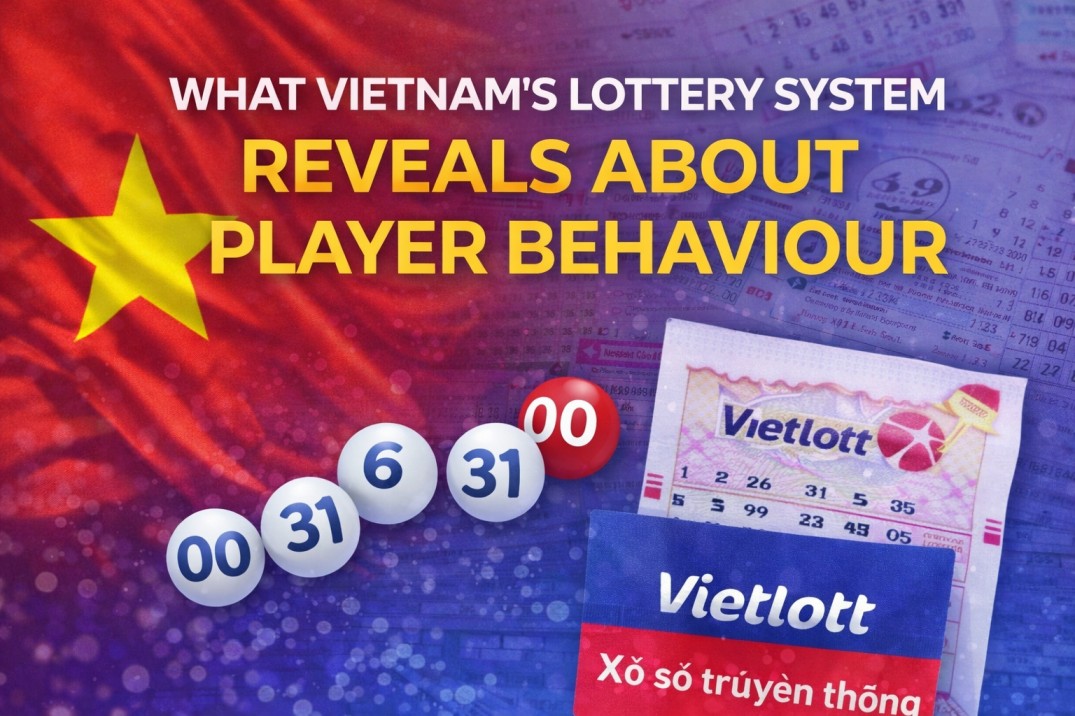
Vietnam’s lottery ecosystem is unusual in a way that most casual observers miss. It is not one lottery system but two parallel belief systems running side by side.
On one side is Vietlott, the modern, number-based, probability-driven lottery.
On the other is Xổ số truyền thống, the traditional provincial lottery rooted in habit, symbolism, and routine.
Together, they reveal far more about human behaviour than about luck.
Two Lotteries. Two Mindsets.
Vietnam officially operates:
- A national digital lottery system run by Vietlott
- A decentralised provincial lottery system run daily across regions
Both sell tickets.
But they attract very different types of players.
Behaviour Pattern 1: Frequency Beats Probability
Traditional provincial lotteries draw every single day.
This creates a behaviour loop:
- Buy today
- Check today
- Repeat tomorrow
Players are not chasing jackpots.
They are chasing routine and emotional continuity.
In behavioural terms, this mirrors:
- Daily stock trading
- Habitual mobile gaming
- Low-stake, high-frequency betting
The probability of winning matters less than the certainty of participation.
Behaviour Pattern 2: Small Wins Matter More Than Big Dreams
One of the most striking insights from Vietnam’s lottery data is this:
Most winners are not jackpot winners.
In games like Mega 6/45:
- Thousands win small prizes
- Very few win the jackpot
- Yet participation remains strong even without jackpot excitement
This shows a key truth:
Small, frequent rewards reinforce behaviour better than rare life-changing ones.
Psychologically, this is variable reinforcement, the same mechanism used in:
- Social media notifications
- Gaming loot boxes
- App streaks
Behaviour Pattern 3: Geography Shapes Trust
In traditional lotteries:
- Tickets are sold locally
- Draws are associated with provinces
- People trust what feels close to home
In contrast, Vietlott is:
- Centralised
- Digitised
- Statistically fair but emotionally distant
This creates a split:
- Urban, younger players lean toward Vietlott
- Older and rural players prefer provincial lotteries
Trust is not built on math.
It is built on familiarity.
Behaviour Pattern 4: Transparency Is Watched, Not Believed
Vietnamese players closely observe:
- Draw videos
- Published numbers
- Prize tables
Yet belief does not fully depend on transparency.
Instead, players look for:
- Patterns
- Repeating numbers
- Personal number logic
This is classic apophenia. Humans find meaning even where randomness exists.
The system reveals that seeing transparency does not eliminate superstition.
It simply coexists with it.
Behaviour Pattern 5: Time Matters More Than Odds
Vietlott draws happen on fixed evenings.
Provincial lotteries happen at predictable daily times.
This matters because:
- Players align lottery checking with daily life
- The draw becomes an event, not just a result
The behaviour here mirrors:
- News consumption habits
- Prime-time TV viewing
- Evening mobile usage spikes
Lottery participation is tied to time rituals, not rational evaluation.
What This Means for Anyone Studying Human Behaviour
Vietnam’s lottery system quietly proves five universal truths:
- People value habit over probability
- Small wins sustain engagement better than big promises
- Local trust often beats institutional transparency
- Humans seek patterns even in randomness
- Timing creates loyalty more effectively than incentives
This is not a lottery lesson.
It is a human behaviour lesson.
Why This Matters Beyond Gambling
The same behavioural mechanics appear in:
- Fintech apps
- Subscription platforms
- Media consumption
- Social networks
- Even political messaging
Vietnam’s lottery system is simply a clean, observable model of how people behave when money, hope, and routine intersect.
FAQs On What Vietnam’s Lottery System Reveals About Player Behaviour
Is Vietlott replacing traditional lotteries in Vietnam?
No. Both systems coexist and serve different psychological and demographic needs.
Why do people still play traditional lotteries despite lower jackpots?
Because frequency, familiarity, and routine matter more than jackpot size.
Do Vietnamese players rely on statistics when choosing numbers?
Some do, but many rely on personal meaning, repetition, and symbolic logic.
What makes Vietnam’s lottery system unique globally?
The parallel operation of a modern national lottery alongside daily provincial lotteries at scale.
The two-tiered lottery system in Vietnam really highlights the diversity of motivations that drive human behavior. It’s not just about winning the jackpot, but rather about participating in something that provides daily emotional engagement. This insight into habitual gambling is really eye-opening.