
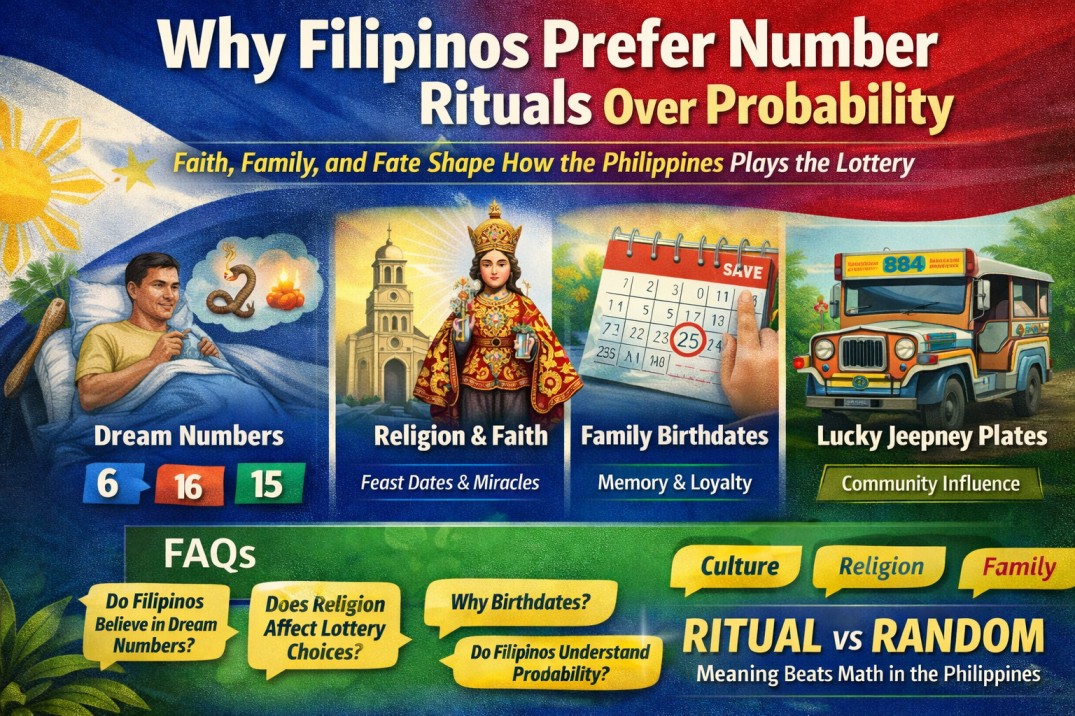
Faith, Family, and Fate Shape How the Philippines Plays the Lottery
In the Philippines, lottery numbers are not picked.
They are received.
From dreams and birthdays to church visits and jeepney plates, numbers come with stories. Probability exists, but it rarely leads. Ritual does.
This is not superstition alone. It is culture, psychology, and survival instinct working together.
The Core Difference: Math vs Meaning
Probability says every number has an equal chance.
Filipino players know this. They simply do not care.
What matters more is meaning.
A number tied to a dream, a death anniversary, a child’s birth, or a religious sign feels chosen. When life is uncertain, chosen numbers feel safer than random ones.
Where Do These Numbers Come From?
1. Dreams as Data Sources
Dream interpretation is deeply embedded in Filipino culture.
People wake up, decode symbols, and convert them into numbers. There are informal dream number charts passed across families and communities.
A snake. A fire. A lost tooth.
Each symbol becomes a number.
This is probability replaced by narrative.
2. Religion and Divine Signals
Catholic faith plays a major role.
Devotees of Quiapo Church or followers of Sto. Niño often associate miracles, processions, and dates with lucky numbers.
If a feast day falls on the 9th, 9 stays forever.
Winning is seen less as luck and more as blessing.
3. Family Dates Over Random Picks
Birthdays, wedding dates, death anniversaries dominate number selection.
This turns lottery play into a family memory act.
People replay the same numbers for years. Even decades. Changing numbers feels like betrayal.
Probability encourages switching.
Emotion demands loyalty.
4. Community Influence and Stories
One neighbour wins with dream numbers.
That story travels faster than any math lesson.
In local communities, anecdotal wins overpower statistical truth. Humans trust people more than percentages.
The Psychology Behind It
Let us break it down simply.
Control Illusion
Ritual creates the feeling of control in an uncontrollable game.
Choosing numbers based on rituals feels active. Random numbers feel passive.
Hope Anchoring
Rituals anchor hope to personal meaning.
When you lose with a random number, it is just loss.
When you lose with your child’s birthday, you can try again.
Poverty and Probability
In economies where daily life already feels probabilistic, people seek certainty elsewhere.
Ritual gives emotional certainty even if outcomes stay random.
Why Probability Fails to Convert Filipino Players
Probability speaks in percentages.
People live in stories.
A 1 in 14 million chance means nothing compared to a dream that felt real.
This is why:
- Quick Pick adoption stays low
- Same numbers are replayed repeatedly
- Ritual based content performs better than odds based messaging
Lottery here is not gambling.
It is hope management.
Global Comparison
India mirrors this with astrology and numerology.
China with number symbolism like 8 and 4.
Brazil shows similar behaviour with birthdays despite PIX driven digital play.
The Philippines stands out because religion, dreams, and family memory overlap strongly.
A Simple Framework: RITUAL vs RANDOM
Ritual gives meaning
Random gives speed
Meaning retains users
Speed increases transactions
In the Philippines, meaning wins.
FAQs
Why do Filipinos believe in lottery number rituals?
Because rituals provide emotional meaning and a sense of control in an uncertain game.
Are dream numbers common in the Philippines?
Yes. Many players rely on dream interpretations and shared number charts.
Does religion influence lottery number choices?
Strongly. Feast days, church visits, and religious symbols often translate into numbers.
Do Filipinos understand lottery probability?
Yes. But cultural belief and personal meaning outweigh mathematical odds.
Why do people replay the same numbers for years?
Because those numbers represent family, memory, and faith. Changing them feels wrong.
The Real Insight
Probability explains how lotteries work.
Ritual explains why people keep playing.
In the Philippines, numbers are not calculated.
They are remembered.
That is why probability will always lose to belief here.