
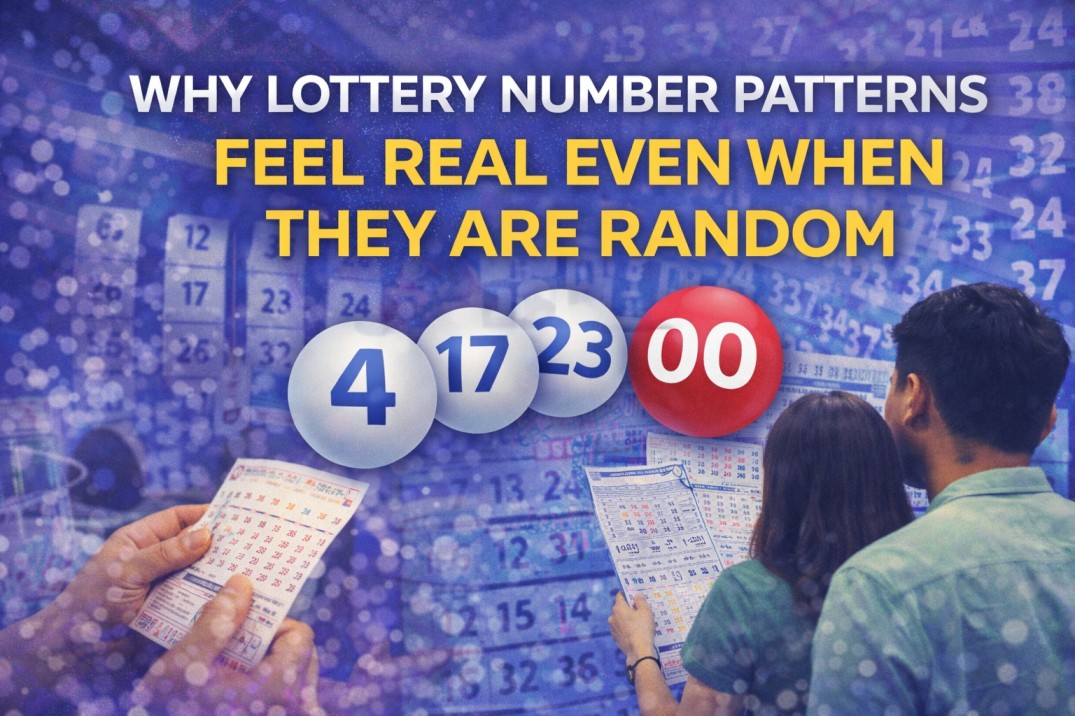
Every lottery player has felt it.
A number appears again.
A sequence feels familiar.
A combination looks “due”.
Even when people know the draw is random, patterns still feel real.
This is not stupidity.
It is human cognition doing exactly what it evolved to do.
The Brain Is a Pattern-Detecting Machine
The human brain did not evolve to understand probability.
It evolved to detect patterns fast, because patterns once meant survival.
- Repeated rustling meant danger
- Familiar paths meant safety
- Cycles meant seasons
So when the brain sees numbers repeating in lottery draws, it treats them like signals, not noise.
Randomness is uncomfortable.
Patterns feel calming.
Random Does Not Mean “Looks Random”
True randomness often produces:
- Clusters
- Repeats
- Streaks
- Gaps
Ironically, perfect randomness looks patterned.
When people expect randomness to look evenly spread, they get confused.
So when they see:
- The same number twice in a week
- Similar ranges appearing
- Close sequences
They assume something meaningful is happening.
Nothing is.
But the brain insists otherwise.
The “Hot” and “Cold” Number Illusion
Many players track:
- Hot numbers that appear often
- Cold numbers that have not appeared recently
This feels logical.
But each draw resets probability completely.
A number that appeared yesterday:
- Has the same chance today
- As a number that has not appeared for months
Yet the brain treats recent memory as relevance.
This is called recency bias, and lotteries expose it brutally.
Near Misses Create False Momentum
Matching 4 or 5 numbers feels like progress.
But statistically:
- A near miss does not increase future odds
- Each draw is independent
Emotionally, though, the brain says:
“I am getting closer.”
This creates the illusion of momentum, even when no momentum exists.
It is the same mechanism used in:
- Slot machines
- Gaming reward systems
- Social media streaks
Near misses keep people engaged without delivering certainty.
Personal Meaning Overrides Probability
Birthdays.
Anniversaries.
A child’s age.
A house number.
These numbers matter emotionally.
Using them does not improve odds, but it improves ownership.
If the ticket loses:
“It was my number.”
If it wins:
“It was meant to be.”
Personal meaning reduces regret.
Random selection increases blame.
So people choose meaning over math.
Humans Prefer Stories to Statistics
A story feels true.
A probability feels abstract.
“Number 17 has appeared 3 times this month”
sounds more convincing than
“Each number has a 1 in X chance every draw.”
Stories compress complexity into something the mind can hold.
Lotteries generate endless micro-stories:
- This number is back
- That number disappeared
- This range is active
None of them change reality.
All of them change perception.
Transparency Does Not Kill Pattern Thinking
Even with:
- Live draws
- Public audits
- Published statistics
People still look for patterns.
Because transparency explains how randomness works, not how it feels.
Feeling is stronger than explanation.
You can show the math.
The brain will still look for meaning.
What Lottery Patterns Really Reveal
Lottery patterns reveal this truth:
Humans are not bad at understanding randomness.
Humans are wired to resist it.
We prefer:
- Familiarity over fairness
- Meaning over accuracy
- Stories over statistics
Lotteries simply expose this tension in its purest form.
Why This Matters Beyond Lotteries
The same thinking drives:
- Stock market bubbles
- Crypto hype cycles
- Sports betting myths
- Even career decision patterns
Any system that is probabilistic but emotionally charged will trigger pattern-seeking.
Lottery numbers are just the cleanest mirror.
FAQs About Why Lottery Number Patterns Feel Real Even When They Are Random
Are lottery numbers truly random?
Yes. Each draw is independent and does not remember past results.
Why do some numbers seem to appear more often?
Randomness naturally creates clusters and repeats, which humans interpret as patterns.
Do hot or cold numbers actually exist?
No. They exist psychologically, not statistically.
Why do near misses feel meaningful?
Because the brain interprets closeness as progress, even when odds do not change.
Can understanding this reduce gambling bias?
Awareness helps, but emotional pattern-seeking is deeply ingrained.