
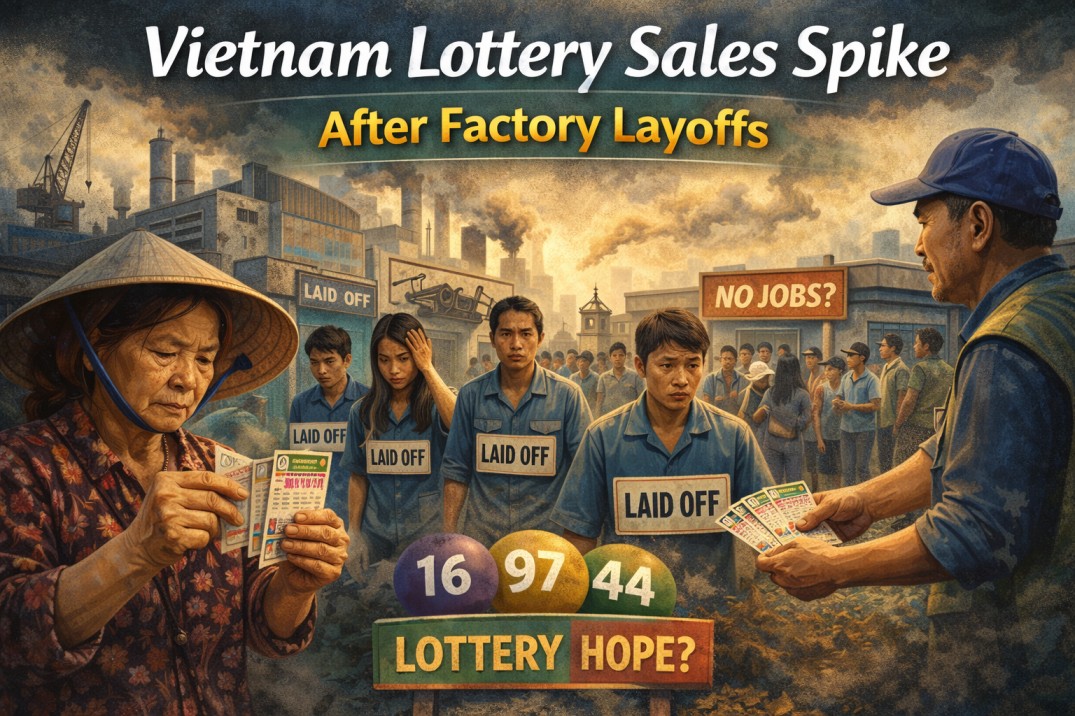
When factories in Vietnam announce layoffs, something unusual happens within days.
Lottery ticket sales go up.
Not marginally. Noticeably.
To an outside observer, this looks irrational. People losing jobs should save money, not spend it on lottery tickets. But in Vietnam, this behavior follows a very clear emotional and economic logic.
This is not gambling behavior.
This is crisis behavior.
And it tells us far more about job insecurity, migration stress, and hope economics than about luck.
Vietnam’s Factory Economy in Simple Terms
Vietnam’s growth story is built on factories.
Textiles, footwear, electronics, assembly units for global brands. Millions of workers migrate from rural provinces to industrial zones around Ho Chi Minh City, Binh Duong, Dong Nai, Bac Ninh, and Hai Phong.
The deal is simple.
- You leave your village
- You live in shared housing
- You work long shifts
- You send money home
- You accept instability as the price of income
When global demand slows or orders drop, layoffs come fast.
No long notice.
No golden handshake.
Sometimes no clarity on what comes next.
What a Layoff Actually Means for a Worker
A factory layoff in Vietnam is not just job loss.
It triggers five immediate fears.
- Rent is due in days
- Family back home depends on remittances
- Returning to the village feels like failure
- Finding another factory job can take weeks
- Savings are thin or non existent
This is where rational planning breaks down.
Not because people are careless.
Because uncertainty overloads the brain.
Why Lottery Purchases Increase After Layoffs
The lottery ticket becomes a psychological shortcut.
Here is the real thought process, simplified.
“I have no control over the next few weeks. This ticket gives me at least one possible outcome where everything is solved.”
That outcome does not need to be likely.
It only needs to exist.
This is why lottery sales spike immediately after layoffs, not months later.
The ticket is not bought for profit.
It is bought to reduce panic.
The Rural Migrant Mindset Factor
Most factory workers in Vietnam are rural migrants.
They grow up with lottery culture.
Village lotteries, daily number tickets, informal draws. Lottery is familiar, social, and discussed openly.
When crisis hits, people return to familiar coping tools.
Not therapy.
Not financial planning.
Familiar rituals.
Buying a lottery ticket is one such ritual.
Daily Lottery Structure Makes It Worse and Better
Vietnam has daily lottery draws.
This matters.
Daily draws create short hope cycles.
- Buy ticket today
- Draw today
- Outcome today
- Repeat tomorrow
This fast cycle is dangerous if abused.
But in crisis moments, it offers quick emotional closure.
Either hope resets tomorrow, or reality settles faster.
This explains why spikes are sharp but often short lived.
Case Pattern Observed Across Industrial Zones
Across multiple layoff events, a consistent pattern appears.
- Week 1 after layoffs. Lottery sales spike
- Week 2. Sales stabilize
- Week 3. Either job found or return migration begins
- Lottery purchases drop back to baseline
This is not addiction.
This is shock absorption.
Why This Is Different From Gambling Addiction
Addiction grows with repetition and escalation.
This behavior does not.
Most laid off workers do not increase ticket quantity. They increase participation temporarily.
One ticket.
Sometimes two.
Rarely more.
The goal is not chasing losses.
The goal is buying time emotionally.
Comparison With India and China
In India, factory layoffs push people toward informal betting, chit funds, or high risk borrowing.
In China, layoffs push people toward savings hoarding and family dependency.
Vietnam sits in between.
Lottery becomes the emotional bridge between fear and function.
It allows workers to survive the first mental shock before making practical decisions.
Why Governments Quietly Tolerate This Spike
Authorities understand something important.
If hope disappears completely, social instability rises.
Lottery absorbs emotional pressure without immediate protest, crime, or unrest.
It is not celebrated.
It is tolerated.
Because it works as a release valve.
What Global Analysts Get Wrong
They look at numbers.
They ignore timing.
Lottery spikes do not mean people are becoming reckless.
They mean people are reacting to sudden uncertainty.
The mistake is calling this irrational behavior.
It is emotionally rational in an unstable system.
What This Means for Modern Lottery and Crypto Platforms
Vietnam responds to systems that feel.
- Accessible
- Transparent
- Low entry
- Not predatory
Platforms that scream jackpots fail.
Platforms that respect uncertainty perform better.
The language should never be greed.
It should be possibility.
Final Thought. When Jobs Disappear, Hope Becomes a Product
In Vietnam, factory layoffs do not just remove income.
They remove certainty.
The lottery steps into that gap.
Not as a promise.
Not as a solution.
But as a pause button for panic.
That is why sales spike.
Not because people believe they will win.
But because for a few hours, they believe things might be okay.
It’s interesting to see how the emotional impact of layoffs, like the stress from migration and job insecurity, can drive people to purchase lottery tickets. It’s not about gambling for luck but rather about the hope for a way out of a tough situation.