
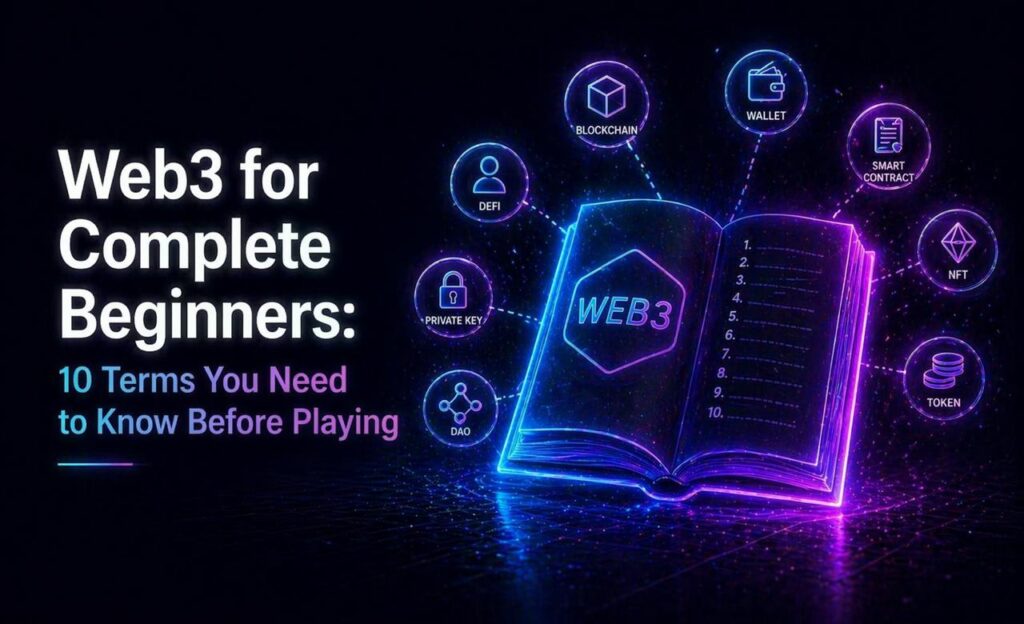
Web3 has its own language. And if you are new to crypto, that language can feel like a barrier before you even get started. Wallet, gas, smart contract, on-chain — these terms get thrown around constantly, but nobody stops to explain what they actually mean.
This guide covers the 10 most important terms you will encounter when using a Web3 platform like KachingVIP No jargon, no assumptions. Just clear explanations you can actually use.
1. Wallet
A crypto wallet is your identity in Web3. It stores your tokens, connects to applications, and signs transactions on your behalf. Unlike a bank account, nobody issues it to you — you create it yourself using an app like Phantom or MetaMask.
When you connect your wallet to a platform like KachingVIP, you are not handing over control of your funds. You are simply telling the platform your public address. Every transaction still requires your explicit approval inside the wallet app.
Your wallet has two key components: a public address, which is like your account number and can be shared freely, and a private key or seed phrase, which controls full access to the wallet and should never be shared with anyone under any circumstances.
2. Seed Phrase
A seed phrase is a series of 12 or 24 randomly generated words that acts as the master key to your wallet. When you create a wallet for the first time, the app generates these words and asks you to write them down.
If you lose access to your wallet — your phone breaks, you forget your password, you switch devices — your seed phrase is the only way to recover it. Anyone who has your seed phrase has complete control of your wallet and everything in it.
Write it down on paper. Store it somewhere safe. Never photograph it, type it into any website, or share it with anyone including support staff from any platform.
3. Blockchain
A blockchain is a public database that records transactions in a way that cannot be altered or deleted. Every transaction is grouped into a block, and each block is connected to the one before it, forming a chain that goes back to the very beginning.
Because the blockchain is distributed across thousands of computers simultaneously, no single person or company controls it. Nobody can go back and change a record that has already been confirmed. This permanence is what makes blockchain useful for things like lottery draws — once a result is recorded, it is there forever and anyone can verify it.
4. Smart Contract
A smart contract is a program that runs automatically on the blockchain when certain conditions are met. Think of it as a vending machine: you put in the right input, and the output happens automatically without any human involvement.
In a crypto lottery, smart contracts handle everything. They collect ticket purchases, execute the draw, select winners, and send payouts — all automatically, all transparently, and all in a way that no one can interfere with after the contract has been deployed.
5. Gas Fee
Gas is the fee you pay to have a transaction processed on a blockchain. When you buy a lottery ticket or claim a prize, the network charges a small fee to the computers that process and record that transaction.
Gas fees vary by network and by how busy the network is at any given time. On some networks they can be significant. On others they are fractions of a cent. KachingVIP shows you the applicable gas fees transparently before you confirm any transaction so there are no surprises.
6. Token
A token is a digital asset that exists on a blockchain. Some tokens are designed to hold value, like USDC which is pegged to the US dollar. Others represent ownership, voting rights, or access to specific services.
KachingVIP accepts hundreds of different tokens as payment for lottery tickets across its supported networks. When you buy a ticket, the platform automatically converts whichever eligible token you hold into USDC to cover the ticket cost.
7. USDC
USDC is a stablecoin, meaning its value is pegged 1:1 to the US dollar. One USDC is always worth one dollar regardless of what the broader crypto market is doing.
KachingVIP pays all prizes in USDC. This means when you win, you know exactly what your prize is worth. There is no volatility between the draw and when you claim your winnings.
8. On-Chain
When something is described as on-chain, it means it is recorded on the blockchain and publicly visible to anyone. An on-chain lottery draw means the result is not just announced by the platform — it is permanently written into the blockchain where any player can independently verify it.
The opposite is off-chain, which refers to activity that happens outside the blockchain, on a company’s private servers or systems. Off-chain processes require trust in the company running them. On-chain processes require trust in the code, which anyone can read.
9. Verifiable Randomness
In a traditional lottery, the winning numbers are generated by the operator, behind closed doors, with no way for players to check the process. In a Web3 lottery, randomness is generated using a Verifiable Random Function, or VRF.
A VRF produces a random result along with cryptographic proof that the result was generated fairly. Anyone can check this proof. Nobody — not the platform, not the developers, not anyone — can predict or manipulate the outcome after the process has begun.
10. Claiming
In crypto, claiming refers to the act of actively requesting a reward that has been assigned to your wallet. Unlike traditional bank transfers, crypto platforms often do not automatically push funds to you. You need to initiate the claim by clicking a button in the platform’s interface.
On KachingVIP, if you win a prize, you need to go to the winnings section and click Claim to receive your USDC. The funds are held by the smart contract until you do so. Unclaimed prizes expire after 30 days, so checking your results regularly is important.
Quick Reference
| Term | What It Means |
| Wallet | Your identity and asset storage in Web3 |
| Seed Phrase | Master key to your wallet — never share it |
| Blockchain | Permanent public record of all transactions |
| Smart Contract | Self-executing code that runs automatically |
| Gas Fee | Small fee paid to process a transaction |
| Token | Any digital asset on a blockchain |
| USDC | Stablecoin worth 1 US dollar |
| On-Chain | Recorded publicly on the blockchain |
| Verifiable Randomness | Provably fair random number generation |
| Claiming | Actively requesting your winnings |
FAQs
1. Do I need to understand all of these terms before I start playing? No. You need a wallet, some tokens, and a basic understanding of what you are approving when you confirm a transaction. The rest becomes clear as you use the platform.
2. What is the most important term on this list? Seed phrase. Losing it means losing your wallet permanently. Sharing it means losing everything in your wallet immediately. No other concept on this list carries that level of risk.
3. Why does KachingVIP use USDC for payouts instead of other tokens? USDC is stable, predictable, and widely usable. Paying prizes in USDC means winners know exactly what they have won the moment the draw completes, with no exposure to token price volatility.
4. What happens if I forget to claim my winnings? Unclaimed prizes expire after 30 days. The platform sends reminder emails before the deadline. Check your results after every draw and claim as soon as you know you have won.
5. Is the blockchain really public? Can anyone see my transactions? Yes. All on-chain transactions are publicly visible. However, your identity is not automatically attached to your wallet address. Your address is visible but connecting it to your real identity requires additional information.