
When you connect your wallet to Kaching and go to buy a ticket, you will see two numbers on the payment screen: Total Available Tokens and Eligible Tokens. Most of the time, these numbers are different. You might hold ten different tokens but only two of them are eligible for payment.
Liquidity is the main reason why. Understanding it takes the confusion out of the checkout experience and helps you make better decisions about which tokens to hold.
What Is Liquidity
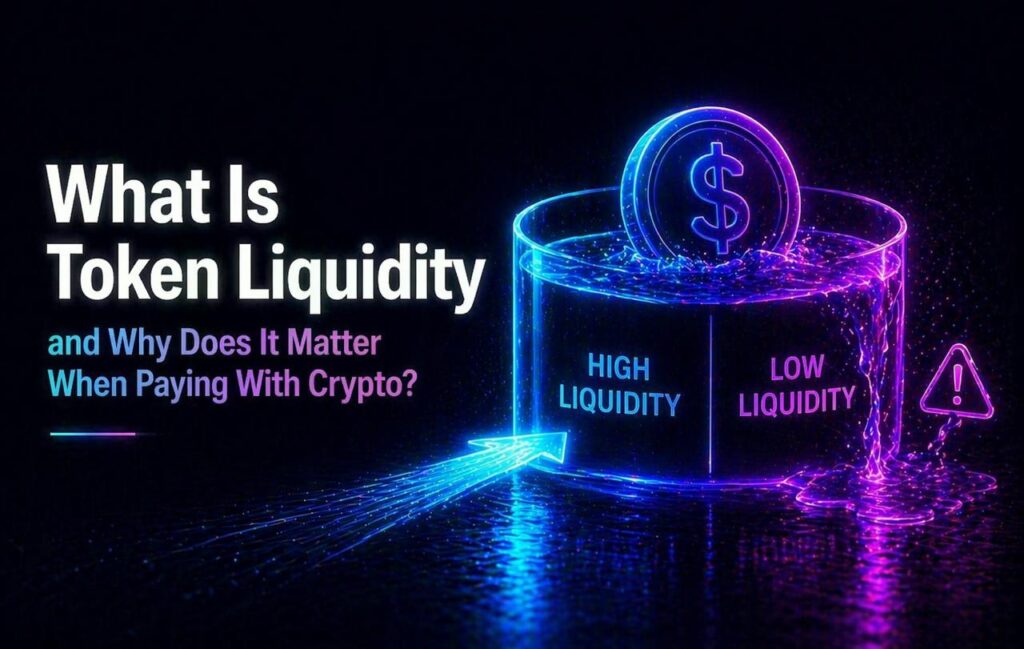
In crypto, liquidity refers to how easily a token can be bought or sold at a stable price. A highly liquid token has lots of buyers and sellers at any given moment, which means large transactions can happen without significantly moving the price. A low liquidity token has few buyers and sellers, which means even modest trades can cause significant price swings.
Think of it like a market stall. A stall selling apples in a busy market can handle dozens of customers at once without running out of stock or having to change prices. A stall selling rare antiques in a quiet side street might struggle to complete even one transaction quickly at the expected price.
Why Liquidity Matters for Token Payments
When you pay for a ticket in KachingVIP using a token other than USDC, the platform needs to convert that token into USDC at the current market rate. This conversion happens through a decentralized exchange, which relies on liquidity pools to function.
A liquidity pool is a reserve of two tokens held in a smart contract. When you swap token A for token B, you are effectively trading with the pool rather than with another person. The pool’s size determines how efficiently the swap can happen and how much the price moves as a result of your transaction.
For a low liquidity token, even a small swap can move the price significantly. This creates unpredictable conversion rates, high slippage, and potentially a failed transaction. For a high liquidity token, the same swap happens smoothly with minimal price impact.
This is why not every token in your wallet is eligible for payment on Kaching. The platform needs to convert your token to USDC reliably and at a predictable rate. Tokens without sufficient liquidity cannot meet that standard.
Total Available Tokens vs Eligible Tokens
When you reach the payment screen on KachingVIP, you will see two figures.
Total Available Tokens shows how many tokens KachingVIP supports on the current network. This is the full list of tokens the platform is able to accept in principle, currently hundreds across supported networks.
Eligible Tokens shows how many of those supported tokens you actually hold in your connected wallet. This is the subset you can use right now for your current purchase.
If you see zero eligible tokens, it means your wallet does not currently hold any of the tokens on KachingVIP’s supported list. The platform will show a message suggesting you switch to a different wallet or add supported tokens before proceeding.
What Makes a Token Eligible
For a token to be eligible on KachingVIP, three conditions need to be met.
The token must be on the platform’s supported list for the current network. KachingVIP maintains and updates this list periodically as liquidity conditions change.
You must hold a sufficient balance of that token in your connected wallet to cover the ticket cost after conversion.
The token must have enough liquidity in the relevant pool to execute the conversion to USDC without excessive slippage. Tokens with very thin liquidity may be removed from the supported list or may result in failed transactions.
Practical Implications for Players
The most reliable way to ensure a smooth purchase experience is to hold tokens with deep liquidity. Major tokens like SOL, USDT, POL, and USDC itself are widely supported and have ample liquidity across all major networks.
Holding a diverse range of tokens including some with established liquidity means you are unlikely to run into an empty eligible tokens screen when you want to buy. If you primarily hold obscure or newly launched tokens, you may find them ineligible even if they appear in your wallet.
The simplest approach of all is to hold USDC directly. Since KachingVIP settles everything in USDC, paying with USDC requires no conversion, no liquidity consideration, and no slippage. The ticket price you see is exactly what you pay.
FAQs
1. What is a liquidity pool? A liquidity pool is a smart contract holding reserves of two tokens that enables decentralized token swaps. When you convert a token to USDC, you are trading with a liquidity pool. The larger the pool, the more stable the conversion rate.
2. Can I add unsupported tokens to KachingVIP’s eligible list? No. The supported token list is maintained by the platform based on liquidity conditions across supported networks. Players cannot add tokens to this list themselves.
3. What is the easiest way to always have eligible tokens? Hold USDC directly. It requires no conversion and no liquidity check. Alternatively, hold major tokens like SOL or USDT which have deep liquidity and are widely supported.
4. What does it mean when Kaching VIP shows zero eligible tokens? It means your connected wallet does not currently hold any tokens from KachingVIP’s supported list in sufficient balance. You can resolve this by adding a supported token to your wallet or connecting a different wallet that holds eligible tokens.