
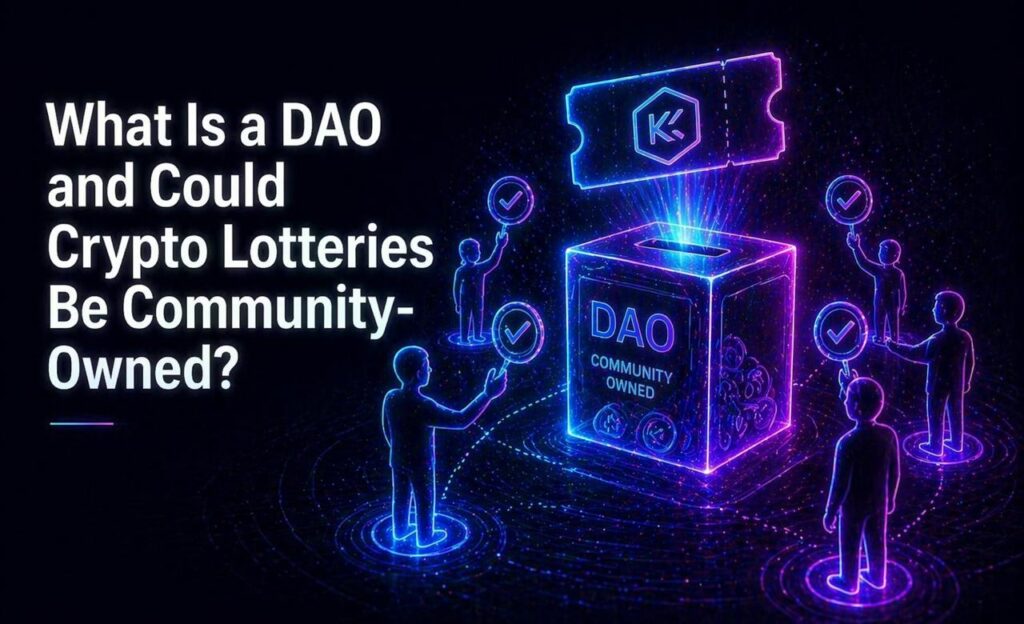
Decentralized autonomous organizations, or DAOs, are one of the most discussed and least understood concepts in Web3. The idea sounds abstract at first. A company with no CEO, no board of directors, and no central office, run entirely by its members through code and collective voting.
But DAOs are already a reality, and the question of whether they could fundamentally change how lotteries are owned and operated is worth taking seriously.
What Is a DAO
A DAO is an organization governed by smart contracts and token holders rather than by traditional management structures. The rules of the organization are written in code and deployed on the blockchain. Decisions are made through voting, where members use governance tokens to signal their preferences.
Anyone who holds the governance token can participate in decisions. How should the treasury be managed? Should the rules of the lottery change? How should prize pools be allocated? In a DAO, these questions are put to a vote rather than decided by a small group of executives.
The key characteristic is that no single person or company controls the outcome. The code enforces whatever the community decides, automatically and transparently.
How Traditional Lottery Governance Works
In a traditional lottery, governance is entirely centralized. A company or government body decides the rules, sets the prize structure, determines the house edge, and controls the treasury. Players have no input into any of these decisions. They accept the terms or they do not play.
This creates a fundamental misalignment between the interests of the operator and the interests of the players. The operator wants to maximize revenue. Players want maximum prize pools, minimum fees, and fair rules. These goals are not always compatible, and the operator always has the final say.
What a Community-Owned Lottery Could Look Like
A DAO-governed lottery would operate differently at every level.
The prize structure would be decided by token holders rather than executives. If the community wanted to increase the jackpot percentage, they could propose and vote on that change. If they wanted to introduce new draw formats, the same process applies.
The treasury would be managed transparently on-chain, with every transaction visible to all members. No executive could quietly redirect funds or adjust the prize pool without community approval.
New features, partnerships, and platform changes would go through a governance process rather than being implemented unilaterally. Players would have a genuine stake in the direction of the platform.
The Challenges of DAO Governance
The theory is compelling. The practice is more complicated.
Voter participation in DAOs is often low. Most token holders do not vote on most proposals, which means a small number of highly engaged members make decisions on behalf of everyone. This can recreate the concentration of power that DAOs are supposed to eliminate.
Governance attacks are also a real risk. If a bad actor acquires enough governance tokens, they can push through proposals that benefit themselves at the expense of the broader community. Smart contract design can mitigate this, but it cannot eliminate it entirely.
Speed is another challenge. Centralized companies can make decisions quickly. A DAO governance process takes time. For a lottery platform that needs to respond to technical issues or market changes rapidly, slow governance can be a liability.
Where Crypto Lotteries Are Today
Most crypto lottery platforms today, including KachingVIP, operate with centralized development teams that maintain and improve the platform. The draws themselves are decentralized — executed by smart contracts that no one can manipulate — but the platform decisions are made by the team.
This is a pragmatic approach for early-stage platforms. Building a user base, iterating on product features, and ensuring security all benefit from clear decision-making authority. The transparency of on-chain operations provides accountability without requiring full governance decentralization from day one.
The path toward greater community ownership is open. As platforms mature and governance tooling improves, progressive decentralization — gradually transferring more decisions to token holders — is a model that several major Web3 projects have followed successfully.
Why This Matters for Players
The governance model of a lottery platform affects players in concrete ways. It determines who decides the prize structure, how the treasury is managed, and what happens when something goes wrong.
A platform that operates transparently on-chain, with verifiable draws and clear rules, gives players meaningful accountability even without formal governance rights. They can verify that the draws are fair, that the prize pool is real, and that the smart contract behaves as described.
As the industry matures, platforms that give players genuine input into governance decisions will have a structural advantage in building long-term trust. The lottery that its players collectively own is harder to abandon than one they merely use.
FAQs
1. What does DAO stand for? Decentralized Autonomous Organization. It is an organization governed by smart contracts and collective token holder voting rather than by traditional management structures.
2. Does KachingVIP operate as a DAO? KachingVIP currently operates with a centralized development team. The draws are executed by smart contracts and are fully decentralized, but platform governance decisions are made by the team.
3. Could a lottery DAO actually work? Yes, in principle. The main challenges are voter participation, governance attack risk, and decision-making speed. Several Web3 projects have implemented DAO governance successfully, though it requires careful design.
4. What is a governance token? A governance token gives its holder the right to vote on decisions within a DAO. The more tokens you hold, the more voting power you have. Governance tokens can be distributed to users, investors, or the community through various mechanisms.
5. What is progressive decentralization? Progressive decentralization is a strategy where a platform starts with centralized control and gradually transfers more decision-making power to the community as the platform matures. It is a common approach for Web3 projects that want to eventually become community-governed without sacrificing operational efficiency in the early stages.