
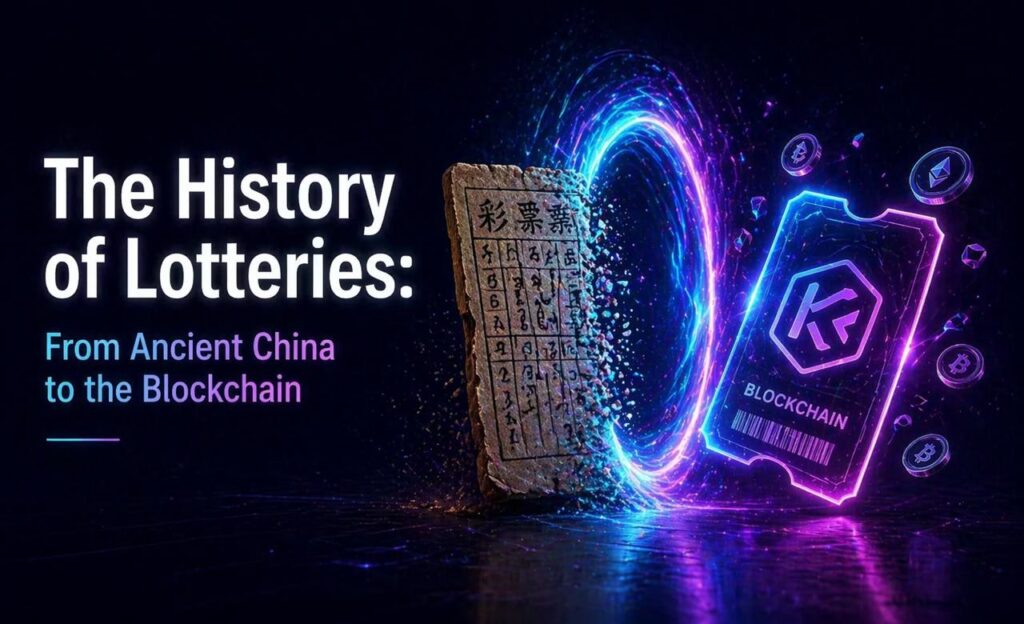
Lotteries are one of the oldest financial instruments in human history. Long before stock markets, central banks, or digital payments existed, civilizations were using randomized draws to distribute resources, fund public works, and generate revenue. The lottery is not a modern invention dressed up in new technology. It is an ancient idea that technology keeps reinventing.
Understanding where lotteries came from makes it easier to understand where they are going. The blockchain is not a disruption of the lottery. It is the latest chapter in a story that has been running for over two thousand years.
The First Lotteries: Ancient China
The earliest recorded lottery-style draws date to the Han Dynasty in China, between 205 and 187 BC. These draws, known as keno slips, were used to fund major government projects including, according to historical accounts, portions of the Great Wall of China.
The principle was simple. Citizens purchased slips, numbers were drawn, and the proceeds funded public infrastructure. The state got revenue. Participants got a chance at a return. The basic exchange at the heart of every lottery since then was already in place.
Rome: Lotteries as Entertainment
The Roman Empire used lotteries differently. Emperor Augustus Caesar organized draws to distribute prizes at public events, using them as a form of entertainment and public relations rather than revenue generation. Guests at imperial dinners would receive tickets and prizes ranging from slaves to real estate would be distributed by draw.
The Romans understood something that modern lottery operators still rely on: the draw creates excitement that pure commerce cannot replicate. Randomness, in the right context, is entertaining.
Europe: Funding Cities and States
The first recorded public lottery in Europe was held in 1445 in the Dutch town of L’Ecluse, with prizes used to fund town fortifications. The format spread quickly across the Low Countries and then across Europe as governments recognized lotteries as a relatively painless form of taxation.
In England, Queen Elizabeth I chartered the first state lottery in 1569 to raise funds for public works. Tickets cost ten shillings, a significant sum at the time, and prizes included tapestries, silver plate, and cash. The lottery was also notable for offering ticket holders freedom from arrest for minor crimes during the draw period, an early example of lottery participation coming with additional benefits.
The Virginia Company of London used a lottery in 1612 to fund the colonization of America. Harvard, Yale, and Princeton universities were partly funded through lottery proceeds in the colonial period. For two centuries, lotteries were one of the primary mechanisms through which public and institutional infrastructure was built in the Western world.
The Prohibition Era and the Return of State Lotteries
By the nineteenth century, lottery corruption had become widespread. Operators manipulated results, prizes went unclaimed or unpaid, and public trust collapsed. Most Western countries banned lotteries by the late 1800s, and the United States followed with a federal ban in 1895.
The prohibition lasted decades. New Hampshire reintroduced the first modern US state lottery in 1964, and other states followed throughout the 1970s and 1980s. The return of state lotteries came with regulation, oversight, and the promise of transparency, though the fundamental trust problem, players relying on operators to run draws fairly, remained unsolved.
The Digital Era: Online Lotteries and the Trust Problem
The internet brought lottery participation online in the 1990s and 2000s. Players could now buy tickets, check results, and claim prizes without leaving home. Participation expanded globally.
But the underlying structure did not change. Online lotteries were still operated by centralized entities. The randomness was still generated behind closed doors. Players still had no way to independently verify whether draws were conducted fairly. The black-box problem that had plagued lotteries for centuries simply moved from physical drawing rooms to digital servers.
Blockchain: The First Real Solution to the Trust Problem
The introduction of smart contracts and verifiable randomness functions created, for the first time in history, a lottery format where players do not need to trust the operator at all.
When a draw is executed by a smart contract, the rules are fixed in code before the first ticket is sold. When the winning numbers are generated using a Verifiable Random Function recorded on the blockchain, any player can independently verify that the draw was fair. When payouts are sent automatically in USDC, there is no operator with discretion over whether and when to pay.
The lottery has always been a compelling idea compromised by a trust problem. Blockchain is the first technology in two thousand years of lottery history that solves that problem structurally rather than just promising to manage it better.
A Timeline of Lottery Evolution
| Era | Format | Trust Mechanism |
| Ancient China (200 BC) | Government keno draws | Imperial authority |
| Roman Empire | Event-based prize draws | Imperial authority |
| Medieval Europe (1400s) | Public town lotteries | Civic institutions |
| Colonial America (1600s-1700s) | Infrastructure funding draws | Local governance |
| Modern state lotteries (1960s+) | Regulated national draws | Government regulation |
| Online lotteries (1990s+) | Digital ticket purchase | Corporate reputation |
| On-chain lotteries (2020s) | Smart contract draws | Cryptographic proof |
FAQs
1. When was the first lottery held? The earliest recorded lottery-style draws date to the Han Dynasty in China around 200 BC, where they were used to fund government infrastructure projects.
2. Why were lotteries banned in the nineteenth century? Widespread corruption, manipulated results, and unpaid prizes eroded public trust. Most Western countries banned lotteries by the late 1800s before gradually reintroducing regulated versions in the twentieth century.
3. How did lotteries fund universities? In colonial America, institutions including Harvard, Yale, and Princeton raised funds through lottery proceeds during the seventeenth and eighteenth centuries, a common method of financing public and educational infrastructure at the time.
4. What makes blockchain lotteries different from online lotteries? Online lotteries moved participation digital but kept the same centralized trust model. Blockchain lotteries use smart contracts and verifiable randomness so players can independently verify that draws are fair, without relying on the operator’s honesty.
5. Is the lottery really two thousand years old? The core concept, paying a small amount for a chance at a larger prize through a random draw, dates back at least two thousand years to ancient China. The format has evolved significantly but the fundamental exchange has remained consistent throughout history.